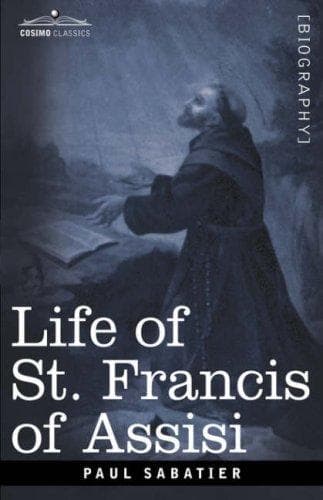
Christian saints -- Biography; Francis, of Assisi, Saint, 1182-1226
The bishop first set forth the case, and advised Francis to simply give
up all his property. To the great surprise of the crowd the latter,
instead of replying, retired to a room in the bishop's palace, and
immediately reappeared absolutely naked, holding in his hand the packet
into which he had rolled his clothes; these he laid down before the
bishop with the little money that he still had kept, saying: "Listen,
all of you, and understand it well; until this time I have called Pietro
Bernardone my father, but now I desire to serve God. This is why I
return to him this money, for which he has given himself so much
trouble, as well as my clothing, and all that I have had from him, for
from henceforth I desire to say nothing else than '_Our Father, who art
in heaven_.'"
A long murmur arose from the crowd when Bernardone was seen to gather up
and carry off the clothing without the least evidence of compassion,
while the bishop was fain to take under his mantle the poor Francis,
who was trembling with emotion and cold.[18]
The scene of the judgment hall made an immense impression; the ardor,
simplicity, and indignation of Francis had been so profound and sincere
that scoffers were disconcerted. On that day he won for himself a secret
sympathy in many souls. The populace loves such abrupt conversions, or
those which it considers such. Francis once again forced himself upon
the attention of his fellow-citizens with a power all the greater for
the contrast between his former and his new life.
There are pious folk whose modesty is shocked by the nudity of Francis;
but Italy is not Germany nor England, and the thirteenth century would
have been astonished indeed at the prudery of the Bollandists. The
incident is simply a new manifestation of Francis's character, with its
ingenuousness, its exaggerations, its longing to establish a complete
harmony, a literal correspondence, between words and actions.
After emotions such as he had just experienced he felt the need of being
alone, of realizing his joy, of singing the liberty he had finally
achieved along all the lines where once he had so deeply suffered, so
ardently struggled. He would not, therefore, return immediately to St.
Damian. Leaving the city by the nearest gate, he plunged into the
deserted paths which climb the sides of Mount Subasio.
It was the early spring. Here and there were still great drifts of snow,
but under the ardor of the March sun winter seemed to own itself
vanquished. In the midst of this mysterious and bewildering harmony the
heart of Francis felt a delicious thrill, all his being was calmed and
uplifted, the soul of things caressed him gently and shed upon him
peace. An unwonted happiness swept over him; he made the forest to
resound with his hymns of praise.
Public-domain text, read in full here on John Shaqi.
Reviews
Reviews
No reviews yet
Be the first to share your thoughts on this work.
Elsewhere in the archive
Join the Discussion
Join the discussion
Sign in to leave a comment or review.
Sign InorCreate an account