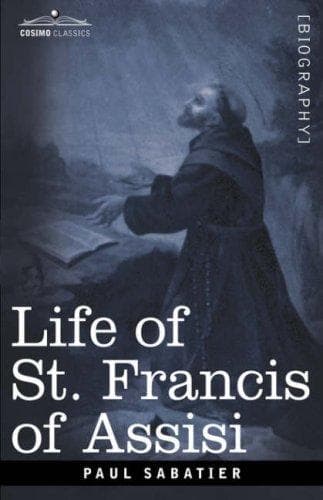
Christian saints -- Biography; Francis, of Assisi, Saint, 1182-1226
These words burst upon him like a revelation, like the answer of Heaven
to his sighs and anxieties.
"This is what I want," he cried, "this is what I was seeking; from this
day forth I shall set myself with all my strength to put it in
practice." Immediately throwing aside his stick, his scrip, his purse,
his shoes, he determined immediately to obey, observing to the letter
the precepts of the apostolic life.
It is quite possible that some allegorizing tendencies have had some
influence upon this narrative.[31] The long struggle through which
Francis passed before becoming the apostle of the new times assuredly
came to a crisis in the scene at Portiuncula; but we have already seen
how slow was the interior travail which prepared for it.
The revelation of Francis was in his heart; the sacred fire which he was
to communicate to the souls of others came from within his own, but the
best causes need a standard. Before the shabby altar of the Portiuncula
he had perceived the banner of poverty, sacrifice, and love, he would
carry it to the assault of every fortress of sin; under its shadow, a
true knight of Christ, he would marshal all the valiant warriors of a
spiritual strife.
FOOTNOTES:
[1] 3 Soc., 26.
[2] 3 Soc., 10.
[3] This crucifix is preserved in the sacristy of Santa Chiara,
whither the sisters carried it when they left St. Damian.
[4] _Opuscula B. Francisci, Oratio I._
[5] 3 Soc., 13; 2 Cel., 1, 6; Bon., 12; 15; 16.
[6] 3 Soc., 14.
[7] This incident is found in the narrative of 1 Cel., 8: _Ibi
ex more venditis_.
[8] 1 Cel., 8; 3 Soc., 16; Bon. 16. Foligno is a three hours'
walk from Assisi.
[9] 1 Cel., 9; 3 Soc., 16; Bon., 6. Cf. A. SS., p. 567.
[10] 1 Cel., 10; 3 Soc., 16; Bon., 17, A. SS.; p. 568.
[11] 1 Cel., 11.
[12] 1 Cel., 12; 3 Soc., 17; Bon., 18.
[13] 1 Cel., 13; 3 Soc., 18.
[14] 1 Cel., 13. It is possible that at this epoch he had
received the lesser order, and that thus he might be subject to
the jurisdiction of the Church.
[15] 3 Soc., 18 and 19; 1 Cel., 14; Bon., 19.
[16] From 1204 until after the death of St. Francis the
episcopal throne of Assisi was occupied by Guido II. Vide
Cristofano, 1, 169 ff.
[17] _Piazza di Santa Maria Maggiore o del vescovado._
Everything has remained pretty nearly in the same state as in
the thirteenth century.
[18] 1 Cel., 15; 3 Soc., 20; Bon., 20.
[19] 3 Soc., 16; Bon., 21.
Public-domain text, read in full here on John Shaqi.
Reviews
Reviews
No reviews yet
Be the first to share your thoughts on this work.
Elsewhere in the archive
Join the Discussion
Join the discussion
Sign in to leave a comment or review.
Sign InorCreate an account