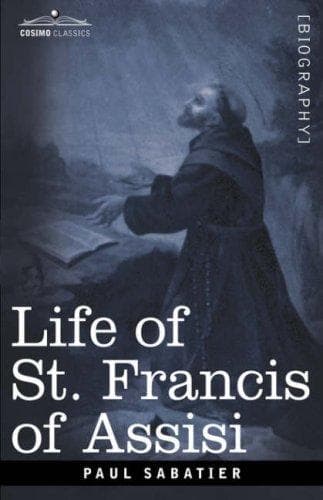
Christian saints -- Biography; Francis, of Assisi, Saint, 1182-1226
A week later, Thursday, April 23, 1209,[7] a new disciple of the name
of Egidio presented himself before Francis. Of a gentle and submissive
nature, he was of those who need to lean on someone, but who, the needed
support having been found and tested, lift themselves sometimes even
above it. The pure soul of brother Egidio, supported by that of Francis,
came to enjoy the intoxicating delights of contemplation with an
unheard-of ardor.[8]
Here we must be on our guard against forcing the authorities, and asking
of them more than they can give. Later, when the Order was definitely
constituted and its convents organized, men fancied that the past had
been like the present, and this error still weighs upon the picture of
the origins of the Franciscan movement. The first brothers lived as did
the poor people among whom they so willingly moved; Portiuncula was
their favorite church, but it would be a mistake to suppose that they
sojourned there for any long periods. It was their place of meeting,
nothing more. When they set forth they simply knew that they should meet
again in the neighborhood of the modest chapel. Their life was that of
the Umbrian beggars of the present day, going here and there as fancy
dictated, sleeping in hay-lofts, in leper hospitals, or under the porch
of some church. So little had they any fixed domicile that Egidio,
having decided to join them, was at considerable trouble to learn where
to find Francis, and accidentally meeting him in the neighborhood of
Rivo-Torto[9] he saw in the fact a providential leading.
They went up and down the country, joyfully sowing their seed. It was
the beginning of summer, the time when everybody in Umbria is out of
doors mowing or turning the grass. The customs of the country have
changed but little. Walking in the end of May in the fields about
Florence, Perugia, or Rieti, one still sees, at nightfall, the bagpipers
entering the fields as the mowers seat themselves upon the hay-cocks for
their evening meal; they play a few pieces, and when the train of
haymakers returns to the village, followed by the harvest-laden carts,
it is they who lead the procession, rending the air with their sharpest
strains.
Public-domain text, read in full here on John Shaqi.
Reviews
Reviews
No reviews yet
Be the first to share your thoughts on this work.
Elsewhere in the archive
Join the Discussion
Join the discussion
Sign in to leave a comment or review.
Sign InorCreate an account