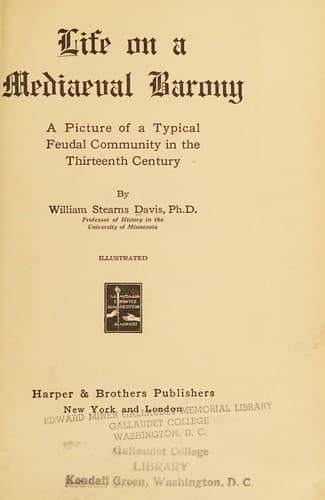
Life on a Mediaeval Barony: A Picture of a Typical Feudal Community in the Thirteenth CenturyDavis, William Stearns
History
Life on a Mediaeval Barony: A Picture of a Typical Feudal Community in the Thirteenth Century
Davis, William Stearns
Chivalry; Civilization, Medieval; Feudalism
Nevertheless, St. Michael and all angels be praised! this evil is
abating. In the direct royal dominions such "men of sin" have been
rooted out since old Louis VI's time. The Church is using its great
influence against evil sires. The communal towns are waxing strong and
sending civic armies to besiege their towers and protect the roads.
The better class of seigneurs also unite against these disgraces to
nobility. As for Baron Garnier, he died betimes, for his suzerain the
duke (weary of complaints) was about to call out the levy of the duchy
and attack St. Aliquis. In other words, law and order are gradually
asserting themselves after the heyday of petty tyrannies, yet there
are still queersome happenings on every seigneury, and the amount of
arbitrary power possessed by the average baron is not good even for a
conscientious and high-minded man.
It is not the theoretical powers of a seigneur, but his actual mental
and ofttimes physical ability, which determines the real extent of
his power. Fiefs are anything but static. They are always growing or
diminishing. A capable seigneur is always attracting new lands to
himself. He ejects unfaithful vassals and adds their estates to his own
personal domain land. He induces his vassal's vassals to transfer their
allegiance directly to him. He wins land from his neighbors by direct
conquest. He induces his neighbor's vassals to desert to the better
protection of his suzerainty. He negotiates advantageous marriage
treaties for his relatives which bring new baronies into his dynasty.
When his own suzerain needs his military aid beyond the orthodox "forty
days," he sells his assistance for cash, lands, or valuable privileges.
Then, often when such an aggressive seigneur dies, his whole
pretentious fief crumbles rapidly. His eldest son is entitled to the
central castle, and the lion's share of the barony, but not to the
whole. The younger lads each detach something, and the daughters cannot
be denied a portion.[43] The suzerain presses all kinds of demands upon
the weakened heir. So do neighboring seigneurs who are the new baron's
feudal equals. One little quarrel after another has to be compounded
after ruinous concessions. Worst of all, the direct vassals of the
incoming baron refuse him homage, hunt up more congenial suzerains, or,
if swearing fealty, nevertheless commit perjury by the treacherous way
they execute their oaths. In a few years what has appeared a powerful
fief, under a young or incapable baron seems on the very edge of
ruin--its lord reduced to a single castle, with perhaps some question
whether he can defend even that.
[Sidenote: Accession to a Barony]
Public-domain text, read in full here on John Shaqi.
Reviews
Reviews
No reviews yet
Be the first to share your thoughts on this work.
Elsewhere in the archive
Join the Discussion
Join the discussion
Sign in to leave a comment or review.
Sign InorCreate an account