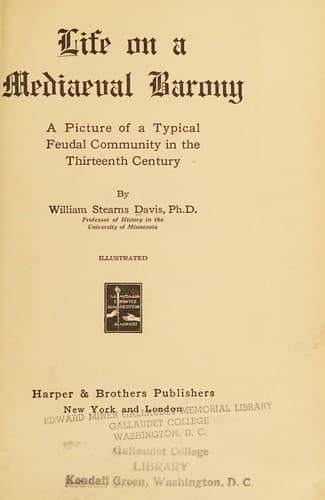
Life on a Mediaeval Barony: A Picture of a Typical Feudal Community in the Thirteenth CenturyDavis, William Stearns
History
Life on a Mediaeval Barony: A Picture of a Typical Feudal Community in the Thirteenth Century
Davis, William Stearns
Chivalry; Civilization, Medieval; Feudalism
Meantime the happy new cavaliers hold their horses motionless for
an instant while their squires run to them with their lances and
triangular shields. The lances have long bright pennons with three
tails which float down upon their riders' helmets. This act performed,
the riders put their steeds through all manner of gallops and
caracoles, and next, "singing high with clear voice," away they go,
flying toward a place on the exercise ground where the _quintain_--the
wooden manikin warrior--has been set up.[64] To smash its shield
and fling it to the ground with a single lance thrust is another
unescapable test. This ordeal also is met by Aimery and his peers with
tolerable glory for all. After this sport the new knights are expected
to _behourder_--that is, to indulge in mock duels with blunted weapons.
These were not counted serious contests, but often enough, if blood is
high and rivalry keen, they can take on the form of vigorous combats.
To-day, however, everybody is in too good humor for violent blows;
besides, the real tournament begins to-morrow, and it is best to keep
strength and weapons until then.
The morning is now spent. Seigneurial appetites have been nobly
whetted. The pavilions are again ready in the garden, and the cooks
have prepared pasties, joints of meat, and great quantities of roast
poultry, even as for the wedding feast. There is another round of
gorging and guzzling, only this time the six new knights occupy the
place of honor, and the master jongleur's story is not concerning sad
Tristan, but about how brave Godfrey of Bouillon stormed Jerusalem.
Everybody is commenting upon the admirable grace, modesty, and
proficiency in arms of Sire Aimery. A count has approached Conon
already before dinner. "Fair Baron, you have a brother who is a credit
to your name. Is it true he is to receive Petitmur? I have a daughter
in her fifteenth year; her dowry will be----"
But Conon tactfully shrugs his shoulders. "Fair Count, my brother will
indeed receive Petitmur; but to-day he is knighted and can speak for
himself. Make your marriage proposals to him. I have no longer the
right to control him."
FOOTNOTES:
[60] Lances grew longer and stouter in the later Middle Ages. In the
fourteenth century they were about fifteen feet long and were a kind of
battering rams designed to dash one's opponent out of the saddle, even
if his armor were not pierced.
[61] Another weapon not infrequently used was the mace, an iron-headed
war club with a fairly long handle. In powerful hands such a weapon
could fell the sturdiest opponent, however good his armor. The mace was
somewhat the favorite of martial bishops, abbots, and other churchmen,
who thus evaded the letter of the canon forbidding clerics to "smite
with the edge of the sword," or to "shed blood." The mace merely smote
your foe senseless or dashed out his brains, without piercing his lungs
or breast!
Another weapon especially common in the early Middle Ages was the
battle ax.
Public-domain text, read in full here on John Shaqi.
Reviews
Reviews
No reviews yet
Be the first to share your thoughts on this work.
Elsewhere in the archive
Join the Discussion
Join the discussion
Sign in to leave a comment or review.
Sign InorCreate an account