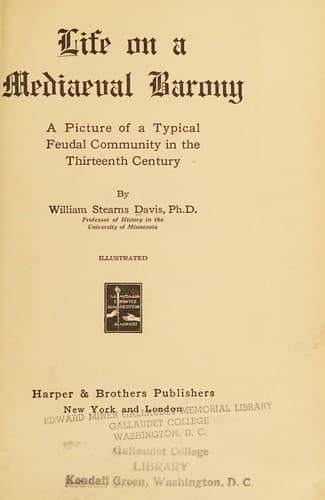
Life on a Mediaeval Barony: A Picture of a Typical Feudal Community in the Thirteenth CenturyDavis, William Stearns
History
Life on a Mediaeval Barony: A Picture of a Typical Feudal Community in the Thirteenth Century
Davis, William Stearns
Chivalry; Civilization, Medieval; Feudalism
The castle folk and the burghers are none too careful in sanitary
matters, but even to them the peasants are disgustingly filthy. They
relate in Pontdebois this story: "Once a villein, leading some
donkeys, went down the lane of the perfumer's shops. Instantly he
fainted at the unaccustomed odor. They brought him to, however, by
holding a shovel full of manure under his nose." Another story (told
at the monastery) has it that the devil has refused to receive more
villeins into hell because they smell so vilely!
In the village you soon find many typical peasant characters, and
nearly all of them are bad. There is the surly fellow who will not even
tell a traveler the way. There is the malcontent villein who mutters
enviously whenever he sees a knight riding out hawking; there is the
mad fool who reviles God, saints, Church, and nobility; there is the
talkative villein who is always arguing bad causes before the provost's
court and inciting his neighbors to senseless litigation, there is the
honest simpleton who wandered up to Pontdebois and got his pockets
picked while gaping at the sculptures on the portal of the cathedral;
finally, there are the misers, the petty speculators in grain (who pray
for a famine), and all the tribe of poachers. Certainly there are also
a great number of hard-working, honest folk who bow respectfully when
Messire Conon rides by and who pay their taxes without grumbling. Such
give prosperity to the seigneury; but it is the rascals who ever thrust
themselves into prominence.
The St. Aliquis villeins seem doltish and dirty enough, but they
are nothing to those existing in Flanders. Some monks have recently
returned thence after doing business for their order. They tell with
horror that in summertime Flemish peasants are seen around their
villages, taking their ease, with no more clothes on than when they
were born. When the monks remonstrated, the rough answer was: "How is
this your business? You make no laws for us." It is pitiful (say the
monks) that any seigneur should tolerate such things on his fief, for
the peasants are such sodden creatures they cannot of themselves be
expected to know better.
If the knights exploit the peasants, the clergy do so hardly less. It
is notoriously hard for the bishop's tithe collector to secure the
quota of pigs, hens, eggs, wheat, vegetables, etc., which everybody
knows that the villein owes to the Church after or upon the same time
he satisfies the collectors for the baron. Indeed, certain impious
villeins complain, "The tithe is worse than the imposts and the
_corvées_." The monkish preachers have to be constantly threatening
these sinners who pay their tithes slowly. The Church tithe is the
property of God. "It is the tax you owe to God, a sign of his universal
dominion." Those who withhold it not merely imperil their souls, but
God will send them "drought and famine," punishing them alike in this
world and the next.
Public-domain text, read in full here on John Shaqi.
Reviews
Reviews
No reviews yet
Be the first to share your thoughts on this work.
Elsewhere in the archive
Join the Discussion
Join the discussion
Sign in to leave a comment or review.
Sign InorCreate an account