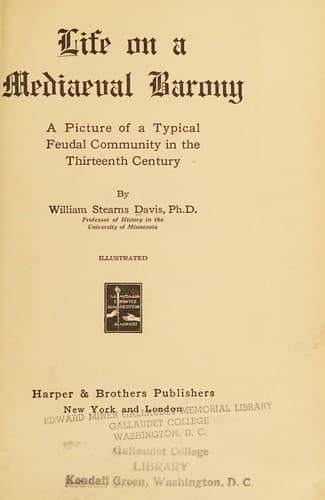
Life on a Mediaeval Barony: A Picture of a Typical Feudal Community in the Thirteenth CenturyDavis, William Stearns
History
Life on a Mediaeval Barony: A Picture of a Typical Feudal Community in the Thirteenth Century
Davis, William Stearns
Chivalry; Civilization, Medieval; Feudalism
The interment took place in the abbey church, in the transept where
rested so many of the St. Aliquis stock. They laid upon the Lady
Odelina's breast a silver cross engraved with the words of absolution;
and in the heavy stone casket also were buried four small earthen pots,
each of which had contained some of the incense burned during the
funeral ceremony. Finally, when the rites were over, Conon employed a
cunning sculptor to make a life-size marble effigy of his mother, to
rest upon the slab covering her tomb--an effigy which, by the dignity
and genuine peace of form and face, was long to express how truly noble
had been his gracious mother.
Common folk cannot have marble caskets and effigies, but even poor
peasants are graced with decidedly elaborate funerals. When a person of
the least consequence in the village dies, a crier goes down all the
lanes, ringing a bell and calling out the name of the deceased, adding,
"Pray God for the dead." Peasants of quality are likely to be laid away
in plaster coffins, although the poorest class of villeins are wrapped
only in rags and tossed into shallow pits.
Still worse is the fate of those who die excommunicated by the Church
or of suicides. These unfortunates cannot even be buried in holy
ground. Their bodies are often exposed, to be torn by the dogs and
crows. Sometimes, however, a hardened sinner repents sufficiently on
his deathbed to be restored to the graces of religion. But in this case
his body is frequently burned, all laden with iron or brazen fetters.
The idea is thus to mortify the body, even after the breath of life has
departed, and so to abate those fires in purgatory assuredly awaiting
for all save great saints, who can pass straight to heaven, or the
numerous reprobates whose guilt requires not temporary, but eternal
torment.
FOOTNOTES:
[82] As a result of this attitude, such a distinguished and genuinely
learned scholar as Albert the Great is said to have confounded tendons
and nerves.
[83] A mediæval medical treatise deliberately advises the use of
this argument to silence patients when the physicians cannot make a
diagnosis, yet must say something.
Chapter XVIII: Popular Religion. Pilgrimages. Superstitions. Relic
Worship.
All the folk of St. Aliquis are Christians. Nobody, far and wide,
except a few Jews in Pontdebois, openly dissents from the Catholic
religion, denies the validity of the creeds, or refuses a certain
outward conformity to the Church practices. The age is not greatly
interested in improving the general moral and social condition of the
common people. The common people even are not always interested in this
themselves. Each peasant prays for "just treatment" and for good luck.
Otherwise, castle and village alike accept as a kind of natural law
the immutability of society. God has established the various orders
and gradations. All that one can ask is that each man shall accept the
condition assigned to him and live in it efficiently and happily.
Public-domain text, read in full here on John Shaqi.
Reviews
Reviews
No reviews yet
Be the first to share your thoughts on this work.
Elsewhere in the archive
Join the Discussion
Join the discussion
Sign in to leave a comment or review.
Sign InorCreate an account