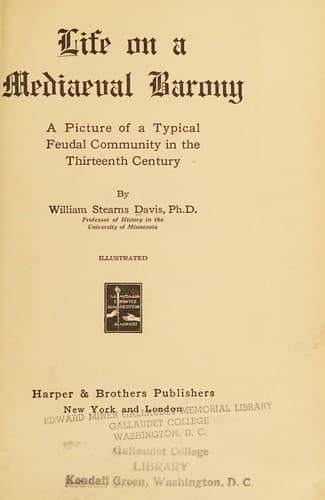
Life on a Mediaeval Barony: A Picture of a Typical Feudal Community in the Thirteenth CenturyDavis, William Stearns
History
Life on a Mediaeval Barony: A Picture of a Typical Feudal Community in the Thirteenth Century
Davis, William Stearns
Chivalry; Civilization, Medieval; Feudalism
[Sidenote: Mystery Plays]
At Easter there are other mystery plays telling the story of the divine
Passion and of the Resurrection; and still others come at intervals
through the year. Some of the participants are priests, but many others
laymen, both men and women.[86] All the more important episodes in
the Bible are acted out with considerable detail and with much comedy
interspersed. The crowds howl with glee when Ananias, like a shrewd
Jew, chaffers for the sale of his field, or when hideous devils leap up
from hell to seize Herodias's daughter the instant she has accomplished
her wicked will with John the Baptist. There is no attempt to represent
ancient times. Herod is dressed like a feudal duke, and before him is
carried a crucifix. The numerous devils are always black; the angels
wear blue, red, and white; "God" appears wearing a papal tiara; and the
"souls of the dead" appear covered with veils--white for the saved,
red or black for the damned. It is a source of great delight for the
people to take part in these plays, and even the great folk are not
above joining in them. One need not comment on how completely such
proceedings impress the imaginations of the unlearned with the stories
of the Old and New Testaments. The Bible can be _read_ only by the few,
but an essential part of it is _seen_ and reasonably comprehended by
the many.
So much for ordinary religious beliefs and occasions. But there are
plenty of people who find their sins are so terrible that they must
resort to some great penances, often consuming the remainder of
their lives, in order to propitiate Heaven. Besides the monks and
the nuns dwelling in convents, there exist a great many hermits and
"religious solitaries," who abide in little huts in the woods, perhaps
maintaining a tiny chapel for travelers, and being fed on the offerings
of forest rangers and peasants. Not all these hermits live, however,
in genuine solitude. Right in St. Aliquis village there is something
everywhere common--a female recluse.
Many years ago, a certain peasant woman, Elise, murdered her husband.
She was promptly condemned to the gallows, but Baron Garnier, with
unusual mercy, pardoned her on condition "that she be shut up within
a small house in the cemetery, that she might there do penance and so
end her days." A stone hut was accordingly built, and the unhappy woman
conducted thither with a regular procession, two priests blessing the
hut and giving Elise a kind of consecration. She was put inside. Every
aperture was then built up except a narrow chink to admit air, a little
light, and a small dole of food from her relatives.
Public-domain text, read in full here on John Shaqi.
Reviews
Reviews
No reviews yet
Be the first to share your thoughts on this work.
Elsewhere in the archive
Join the Discussion
Join the discussion
Sign in to leave a comment or review.
Sign InorCreate an account