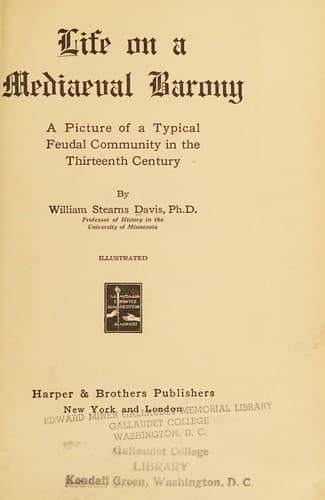
Life on a Mediaeval Barony: A Picture of a Typical Feudal Community in the Thirteenth CenturyDavis, William Stearns
History
Life on a Mediaeval Barony: A Picture of a Typical Feudal Community in the Thirteenth Century
Davis, William Stearns
Chivalry; Civilization, Medieval; Feudalism
Assuredly, however, Rome is best (always barring Jerusalem), and on the
way thither the pilgrim can lighten his spiritual load by visiting many
excellent Italian shrines--such as "Our Guardian Lady" at Genoa, and,
at Lucca, "Our Lady of the Rose." In the city of St. Peter itself, time
fails to enumerate the three hundred churches worthy of a devout visit.
Besides the majestic cathedral of the Prince of the Apostles and the
tomb of St. Paul, even the most hurried pilgrim will not fail to repair
to St. Maria Maggiore, where is the actual manger in which Christ was
born; and St. John Lateran, where are the holy stairs Christ ascended
while wearing the crown of thorns; St. Peter in Montorio, where Peter
himself was crucified, St. Lawrence Without the Walls, where the
blessed martyrs St. Stephen and St. Lawrence are buried; not to mention
others. A man must be a master criminal if he cannot deliver his soul
by suitable visits to these invaluable shrines in Rome.
As is well known, the blessed saints both in this life and after death
wrought many miracles through their relics. These wonders continue
to-day, although the iniquities of mankind render them infrequent.
Every now and then Heaven still permits some holy man to work undoubted
miracles. Thus only recently it is said that when the venerable abbot
of St. Germer preached the Fourth Crusade in England, he need only
bless a fountain, lo! its waters made the dumb speak, the blind see,
and the sick recover. Once (so a pilgrim related in the castle only the
other day) when this abbot reached a village which wanted a supply of
water, he gathered all the folk in the church. Right in the presence of
the people he smote a stone with his staff and water flowed forth--not
merely potable, but healing for all maladies.
God also speaks to us in dreams as he did to Pharaoh and
Nebuchadnezzar. He caused St. Thomas à Becket to visit the late king
Louis VII and warn him to make a pilgrimage to St. Thomas's new shrine
of Canterbury to pray for the recovery of his son Philip, later
"Augustus." Henry II of England was Louis' foe, but the king made the
solemn pilgrimage unimpeded, and the crown prince duly recovered.
[Sidenote: Omens, Spirits and Monsters]
Public-domain text, read in full here on John Shaqi.
Reviews
Reviews
No reviews yet
Be the first to share your thoughts on this work.
Elsewhere in the archive
Join the Discussion
Join the discussion
Sign in to leave a comment or review.
Sign InorCreate an account