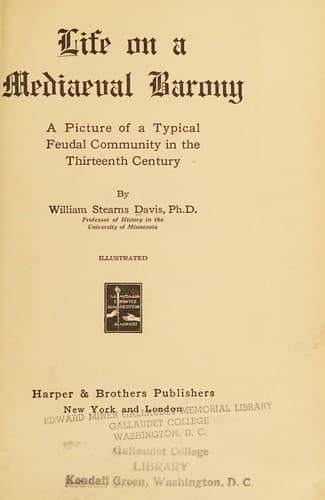
Life on a Mediaeval Barony: A Picture of a Typical Feudal Community in the Thirteenth CenturyDavis, William Stearns
History
Life on a Mediaeval Barony: A Picture of a Typical Feudal Community in the Thirteenth Century
Davis, William Stearns
Chivalry; Civilization, Medieval; Feudalism
Possessing relics is most desirable. Prayers said near them have
extra efficacy. Oaths taken upon their caskets are doubly binding,
but sometimes the holy objects are surreptitiously removed when the
pledge is being given; it is then no perjury to break the promise. In
dealing with slippery individuals one must, therefore, beware. On the
other hand, who is ignorant of the manner in which William the Norman
inveigled Harold the Anglo-Saxon into taking a great oath of fealty?
The slow-witted Englishman swore to the pact, believing the casket on
which he rested his hands contained relics of very inferior worthies,
who could never punish him if he perjured himself; but the instant the
words were said the priests opened the sacred box, showing it full of
the bones of the most powerful saints imaginable. Harold turned pale
with horror, realizing how he had been trapped. When later he broke his
oath, beyond a doubt it was these angered saints who wrought his death
at Hastings.
Good relics also imply a source of income, provided that they are
properly advertised so as to make the church or abbey possessing them a
pilgrimage resort. Sometimes, indeed, one fears lest overzealous monks
exaggerate the miracles wrought by the relics at their abbey church.
The tale runs that when the Abbey of St. Vanne was deeply in debt, the
abbot asserted: "Our debts will all be paid with the red tunic of St.
Vanne (a relic). I never doubt it."
The monks at St. Aliquis are proud of their collection, although by no
means the largest in the region. They have two teeth of the prophet
Amos; hairs of St. Martin and St. Leonard; finger-nail parings of the
martyrs of the Theban legion; bits of the robe of St. Bernard; finger
bones of Saints Saturnin, Sebastian, and of the Patriarch Jacob; a
fifth rib of St. Amond; a skull of one of the Holy Innocents; a chip
of the stone on which Christ stood when He ascended to heaven; the jaw
bone of St. Sixtus; some of the hay from the manger of Bethlehem; and,
last but not least, a fair-sized splinter of the true Cross. The mere
adoration of such things cancels many grievous years in purgatory.
It is advantageous to the whole region to have such a collection. If
there is need of rain, the relics can be carried in procession around
the thirsty country and relief is sure to follow. If there is a public
assembly, the holy relics can be brought in before the contending
knights or burghers--wise counsels will ensue. If you are going on a
journey, a visit to a shrine with such relics almost guarantees a safe
return. We have already seen how Conon (as did other knights) kept
certain relics always in his sword hilt, to confirm his oaths and to
lend efficacy to his actions.
[Sidenote: Contests Over Relics]
Public-domain text, read in full here on John Shaqi.
Reviews
Reviews
No reviews yet
Be the first to share your thoughts on this work.
Elsewhere in the archive
Join the Discussion
Join the discussion
Sign in to leave a comment or review.
Sign InorCreate an account