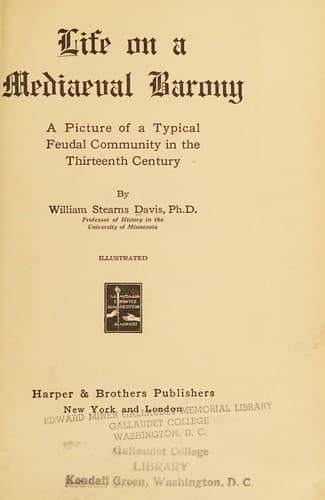
Life on a Mediaeval Barony: A Picture of a Typical Feudal Community in the Thirteenth CenturyDavis, William Stearns
History
Life on a Mediaeval Barony: A Picture of a Typical Feudal Community in the Thirteenth Century
Davis, William Stearns
Chivalry; Civilization, Medieval; Feudalism
In the monastery there are, however, certain very young boys, who it is
to be hoped will prove contented with their profession. Their parents
or guardians have taken them to the abbot, and in their ward's behalf
have uttered vows that bind the helpless children forever. "I offer
this my son (reads the formula) to the Omnipotent God and to the Virgin
Mary for the salvation of my soul and the souls of my parents.... And
so shall he remain in this holy life all his days until his final
breath." Earnestly do the wiser brethren pray that these practically
orphaned boys do not become a source of sorrow to themselves and of
discord to the community in future years.[93]
St. Aliquis is a well-ordered monastery. Its monks, however,
point with some pharisaical satisfaction at certain neighboring
establishments. It is well said that "ten are the abuses in the
cloister--costly living, choice food, noise in the cloister, strife
in the chapter, disorder in the choir, a neglectful discipline,
disobedient youths, lazy old men, headstrong monks, and worldly
officers." It is alleged that all these evils and worse ones have
existed in the monastery of St. Ausonne, five leagues away. This
community had an excellent name for sanctity until twenty years
ago. Then a foolish abbot admitted too many "younger sons" who were
being forced in by their relatives. The duke, likewise, imprudently
pardoned a whole gang of highwaymen on condition that "they should
turn religious." Also, several self-seeking cavaliers deliberately
entered the order, in sinful expectation that family influence could
procure their election as abbots or bishops--posts of great worldly
consequence. Thus it was that our old enemy, Satan, entered into St.
Ausonne. All accounts are that he still refuses to be ejected.
[Sidenote: A Disorderly Monastery]
The evil tidings of this convent presently spread to Rome; and the Holy
Father, deeply grieved, ordered the Bishop of Pontdebois to visit the
establishment and restore discipline.[94] It was well that he took a
troop of armed sergeants with him, or he would have been stoned by the
furious inmates. The monks of St. Aliquis lift their hands in horror
at the least of the stories told about his discoveries. Part of the
bishop's report reads like this: "Brother Regnaud is accused of great
uncleanness of life. Bartholomée, a cantor's assistant, often gets
drunk and then does not get up for the matins service. Roger, the
third prior, frequents taverns. Jean, the fourth prior, is an habitual
tippler. Morell, another cantor's assistant, is given to striking and
evil speaking. Firmin, in charge of the abbey lands, does the like,
etc."
Public-domain text, read in full here on John Shaqi.
Reviews
Reviews
No reviews yet
Be the first to share your thoughts on this work.
Elsewhere in the archive
Join the Discussion
Join the discussion
Sign in to leave a comment or review.
Sign InorCreate an account