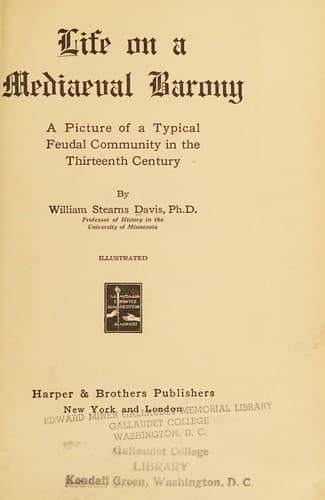
Life on a Mediaeval Barony: A Picture of a Typical Feudal Community in the Thirteenth CenturyDavis, William Stearns
History
Life on a Mediaeval Barony: A Picture of a Typical Feudal Community in the Thirteenth Century
Davis, William Stearns
Chivalry; Civilization, Medieval; Feudalism
For similar reasons many women, unmarriageable through physical
defects, seem to have been placed in nunneries.
[92] In monasteries affiliated with the great abbey of Cluny the
highest officer was the prior; the only abbot for the entire group of
establishments was at Cluny. Various other small dependent monasteries
had merely a prior, supposedly dependent on the abbot at a superior
monastery.
[93] While such children would be sometimes presented out of motives
of genuine piety, to save their own souls or to redeem those of their
relatives, often they were thrust into the convent merely to dispose
of unwelcome heirs or to avoid the cost of rearing them. Wise abbots
would, of course, sift out such cases carefully.
[94] Bishops theoretically had themselves the right of inspection
unless a monastery had a direct papal charter; but in any case the
monks would probably resist episcopal interference vigorously unless
the Pope gave the bishop specific orders to intervene.
[95] These complaints are identical with those actually made by a
worldly monk who visited the venerable abbey of Cluny.
Chapter XX: The Monastery of St. Aliquis: The Activities of Its
Inmates. Monastic Learning.
After a monk has taken the great vow "renouncing my parents, my
brothers, my friends, my possessions, and the vain and empty glory of
this world ... and renouncing also my own will for the will of God,
and accepting all the hardships of the monastic life," how is he to
be employed? For, as St. Benedict with great sagacity has written,
"_Idleness is the enemy of the soul_." The ancient hermits devoted
their entire time to contemplation, hoping for visions of angels; but
it is recorded too often that they had only visions of the devil.
"Therefore," continues the holy Rule, "at fixed times the brothers
ought to be employed with manual labor, and again at fixed times in
sacred reading." Thus, in general, the monks of St. Aliquis are busied
with two great things, _work_ in the fields and _study_, with the
copying or actual writing of profitable books.
[Sidenote: Bequests to Monasteries]
Public-domain text, read in full here on John Shaqi.
Reviews
Reviews
No reviews yet
Be the first to share your thoughts on this work.
Elsewhere in the archive
Join the Discussion
Join the discussion
Sign in to leave a comment or review.
Sign InorCreate an account