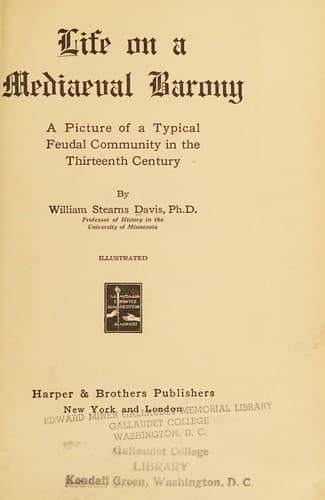
Life on a Mediaeval Barony: A Picture of a Typical Feudal Community in the Thirteenth CenturyDavis, William Stearns
History
Life on a Mediaeval Barony: A Picture of a Typical Feudal Community in the Thirteenth Century
Davis, William Stearns
Chivalry; Civilization, Medieval; Feudalism
If the struggle is bitter, however, the bishop has another weapon.
He can put the offending seigneur's lands and castles under the
Interdict. Doubtless it is a harsh thing to deny all religious services
and sacraments, save the last unction to the dying, to thousands of
innocent persons merely because their lord persists in some worldly
policy. Yet this is done frequently, and is, of course, of great
efficacy in getting pious people, and especially the womenfolk, to
put pressure upon their seigneur to come to terms with the Church.
Sometimes an "intermittent" interdict is established. Thus, for a long
time the Count and the Bishop of Auxerre were at enmity. The count, a
hardened scoffer, was no wise troubled by excommunication. Then the
bishop ordained that as soon as the count entered the city of Auxerre
all the offices of religion, except baptism and last unction, should
be suspended. The moment he and his men departed the church bells rang
and religious life resumed. The instant he returned there was more
bell ringing--whereat the churches were closed. The count did not dare
to stay very long in the city, because of popular murmurs; yet he and
the bishop kept up this unedifying war for fifteen years until the
Pope induced the king to induce the count to submit to the Church by a
humiliating penance.
Excommunication and interdict are thus weapons which a lord spiritual
can use against a lord temporal, to supplement crossbows and lances.
Unfortunately they have fewer terrors against foes which all bishops,
including Nivelon, have within their own household--the chapters of
canons at the cathedrals.
[Sidenote: A Chapter of Canons]
To be a canon is almost equal to enjoying the perquisites of some less
valuable bishopric without the grievous cares of the episcopal office.
The chapter of canons constitutes the privileged body of ecclesiastics
who maintain the worship at the cathedral.
As you go through Pontdebois you see the great gray mass of the new
episcopal church rising ahead of you. Presently a solid wall is
reached, protected by a gate and towers. This is the cathedral "close,"
a separate compound next to the majestic church and communicating with
it by a special entrance. Within this close one passes under strictly
ecclesiastical jurisdiction. Here is a pretentious residence, the
bishop's palace, and a pleasant garden, and here is also a group of
smaller houses--the habitations of the canons. These last form the
chapter of canons who enjoy as a corporate body a quantity of lands,
seigneurial rights, officers, and goodly income quite separate from the
bishops. Supposedly they are controlled by a Rule, but it is a rule far
less severe than that of most monks.
Public-domain text, read in full here on John Shaqi.
Reviews
Reviews
No reviews yet
Be the first to share your thoughts on this work.
Elsewhere in the archive
Join the Discussion
Join the discussion
Sign in to leave a comment or review.
Sign InorCreate an account