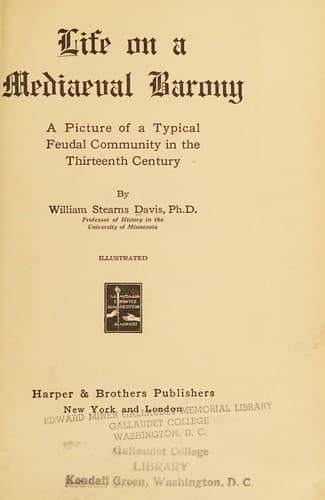
Life on a Mediaeval Barony: A Picture of a Typical Feudal Community in the Thirteenth CenturyDavis, William Stearns
History
Life on a Mediaeval Barony: A Picture of a Typical Feudal Community in the Thirteenth Century
Davis, William Stearns
Chivalry; Civilization, Medieval; Feudalism
It is possible, however, to find substitutes in all the less important
services. There are plenty of humbly born poor priests hovering around
every cathedral, glad of a pittance to act as the lordly canon's
deputies. A worldly minded canon therefore does not feel this duty of
chanting to be very arduous. Of course, if he is absent too often,
or from very important ceremonies, there is comment, scandal, and a
reprimand from the bishop; but a wise bishop does not interfere with
his canons except on grave provocation. They form an independent
corporation with well-intrenched privileges. Their head, the dean, is
entirely conscious that he is the second cleric in the diocese and
that he need not look to the bishop for dignity and glory. The bishop
himself has been to a certain extent chosen by these very canons. It
will depend considerably upon their attitude toward him whether his
dying moments are not embittered by the knowledge that his dearest
enemy is not to be elected his successor. Finally, a chapter of canons
can make a bishop's life a Gehenna by filing complaints against him
with the archbishop (always glad to interfere), or directly at Rome.
When men say that Nivelon has got along tolerably with his chapter as
well as with his neighboring abbot and seigneurs, they prove again that
he is an unusually tactful prelate.
It is a fine thing, therefore, to be one of the dozen-odd canons,
young or old, who inhabit the sacred close at Pontdebois. They can be
identified by their special costume, the loose surplice of linen with
wide sleeves covering the cassock, and by the "amice," a headdress of
thick black stuff with a flat top and terminating on each corner in a
kind of horn.
Baron Conon points out to his sons these well-fed men of florid
complexion, contented and portly, moving with slow dignity about the
cathedral close. "How would you enjoy being a canon?" he asks of small
Anseau, his youngest boy. "There are no better dinners than those in
the chapter refectory; and remember that your brother will have to get
the castle."
Anseau shakes his head and scowls: "I might be a monk, yes," he
rejoined; "monks save their souls and go to heaven--but a canon--ugh!
They must weary God by their idleness. François may have St. Aliquis;
but let him give me a good destrer and good armor. I will seek my
fortune and win new lands."
"The saints bless your words," cries his father, "there spoke a true
St. Aliquis! And remember this: When cavalier or jongleur rails hardest
against worthless churchmen, it is not bishop, priest, or monk whom
half the time they have in their pates, but slothful canons. Yet I
must see the Revered Father Flavien, and learn if his cough _is_ really
as bad as they say!"
Public-domain text, read in full here on John Shaqi.
Reviews
Reviews
No reviews yet
Be the first to share your thoughts on this work.
Elsewhere in the archive
Join the Discussion
Join the discussion
Sign in to leave a comment or review.
Sign InorCreate an account