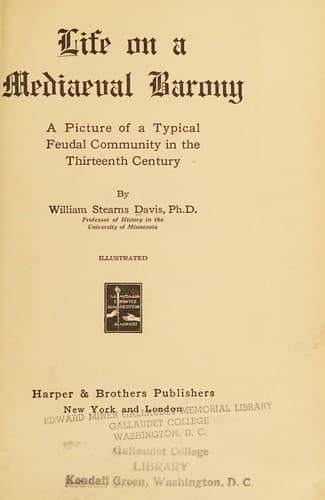
Life on a Mediaeval Barony: A Picture of a Typical Feudal Community in the Thirteenth CenturyDavis, William Stearns
History
Life on a Mediaeval Barony: A Picture of a Typical Feudal Community in the Thirteenth Century
Davis, William Stearns
Chivalry; Civilization, Medieval; Feudalism
These maids are trained to clean the apartments; next to wipe down all
the stools and benches; next to feed the "chamber animals"--dogs and
cage birds. After that the mistress must assign to them their task of
weaving, cutting, sewing, etc. They are fed plentifully, "but only on
one meat, and have only one kind of drink, nourishing but not heady,
whether wine or otherwise." They must also eat promptly, "not reposing
on their meal, or halting or leaning on their elbows," and "they must
rise as soon as they begin to talk and lounge about." After supper they
must go immediately to bed, unless with the remainder of the castle
they sit up for a jongleur.
So passes the routine of many days until at last the prospect dawns
of an event which will tax the full administrative capacities of
the baroness, and which sets Adela and Aimery each in a different
kind of a flutter. Conon is about to give his sister in marriage and
immediately after that to knight his brother. There will be a festival
which will carry the name of St. Aliquis all over northern France.
FOOTNOTES:
[20] These quotations are from Arnaut de Maruelh and Marie de France,
respectively.
[21] All the above advice to noblewomen is from contemporary etiquette
books or clerical writers. The trouvère quoted is Robert of Blois, a
writer of the thirteenth century.
[22] Students of the _Odyssey_ will recall a similar command which
Telemachus addressed to his mother, Penelope. Homeric society and
feudal society had many viewpoints in common.
[23] The directions about engaging servants given in mediæval handbooks
on domestic economy contain much practical common sense for any age.
Chapter VI: The Matter of Clothes. A Feudal Wedding.
Inasmuch as from time immemorial a wedding has seemed primarily a
matter of clothes, what better place than this wherein to consider the
costumes of the good folk of St. Aliquis? Assuredly, the Scripture
warns us, "Take no thought saying ... 'Wherewithal shall we be
clothed?'" but that admonition (so Adela tells the abbot) was doubtless
intended only for the Holy Apostles, not for a Christian woman who must
make a fair showing for her husband in the face of Heaven knows how
many critical baronesses and countesses.
Public-domain text, read in full here on John Shaqi.
Reviews
Reviews
No reviews yet
Be the first to share your thoughts on this work.
Elsewhere in the archive
Join the Discussion
Join the discussion
Sign in to leave a comment or review.
Sign InorCreate an account