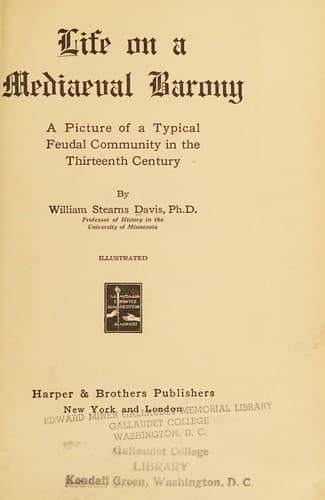
Life on a Mediaeval Barony: A Picture of a Typical Feudal Community in the Thirteenth CenturyDavis, William Stearns
History
Life on a Mediaeval Barony: A Picture of a Typical Feudal Community in the Thirteenth Century
Davis, William Stearns
Chivalry; Civilization, Medieval; Feudalism
If a maiden has a father, a competent brother, or an uncle she is
lucky. Otherwise, the bestowal of her hand belongs to her suzerain.
This right to bestow heiresses or the widows of vassals on faithful
retainers is one of the most precious privileges of a great seigneur.
Many a knight is kept loyal by the hope that presently his lord will
say: "One of my barons is dead without sons. I will give you his
fiefs and his daughter"; or, "Take the widow of the late Sire X....
You may have the land along with the lady." Under feudal usage it is
well-nigh impossible to deprive an heiress of her estates directly,
but her marriage practically gives her husband the ownership of the
property. No wonder the Duke of Quelqueparte is anxious to see whether
the sickly Count of Greve is about to die and leave only a daughter,
so that he can secure the desirable allegiance of the Baron of St.
Saturnin, who has been a widower now these six months, yet has remained
still "uncomforted" just in hope of this particular happening.
[Sidenote: Scandalous Relationships]
What wonder if under these conditions strange romances occur; if the
lady gives "her love and kiss" to some young knight, not her husband;
if South Country troubadours assert that "married couples cannot truly
love;" and if barons sometimes bring irregular consorts straight into
their castles, while perhaps winking at their wives' uncanny doings?
All this is true. Yet, as stated before, not everything is bad. Girls
are taught not to expect too much of their spouses. They usually accept
the situation as they accept stormy or sunny weather. Besides, if some
fathers or guardians are scandalously careless in disposing of their
charges, many fathers and brothers are full of honest affection and
accept the duty of marrying off their daughters or sisters as a solemn
responsibility; and if they are wise custodians the results are usually
happy. There is no need of pitying Alienor too much because she has not
the right to elope.
Conon has negotiated a most satisfactory marriage. He will give his
sister to Sire Olivier, the eldest son of the Count of Perseigne. The
Perseignes are a great Burgundian family with many castles, and counts
think themselves a little higher in the social scale than do barons,
but St. Aliquis is also a powerful fief, and its alliance will be
useful to Perseigne when he has his expected war with the Vidame of
Dijon. Conon will give the young couple his outlying Burgundian castle
(not of great value to himself) and the alliance will enable him to
talk roundly to his uncivil neighbors. A most excellent match; another
sign that St. Aliquis has an extremely sage seigneur!
Public-domain text, read in full here on John Shaqi.
Reviews
Reviews
No reviews yet
Be the first to share your thoughts on this work.
Elsewhere in the archive
Join the Discussion
Join the discussion
Sign in to leave a comment or review.
Sign InorCreate an account