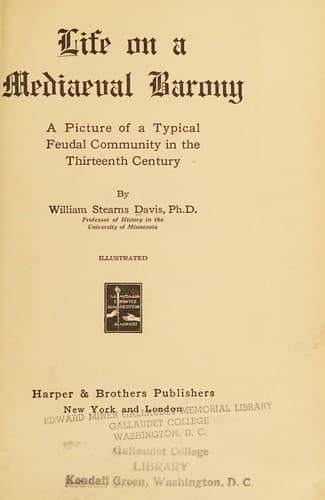
Life on a Mediaeval Barony: A Picture of a Typical Feudal Community in the Thirteenth CenturyDavis, William Stearns
History
Life on a Mediaeval Barony: A Picture of a Typical Feudal Community in the Thirteenth Century
Davis, William Stearns
Chivalry; Civilization, Medieval; Feudalism
Maître Edmond, has, however, another line of business. His opportunity
opens this way. Among Conon's guests is a baron of Harvengt. This rich
seigneur has spent much time in the south country. He has learned
the gay science of the troubadours. Superior minstrels are always
welcome at his castle; in fact, he is something of a minstrel himself.
Indeed, it is claimed he is too much interested in matters which are
primarily only for villeins or at best for the women, and neglects
his hawks, tourneys, and even his proper feuds with his neighbors.
Nevertheless, Orri de Harvengt is an extremely "gentle" man. He
possesses a considerable number of books in Latin--Virgil, Ovid, Lucan,
and others--although a visiting monk has grumbled that nearly all the
volumes are by questionable pagans, and that this baron has almost no
parchments of saints' lives and Church fathers. However, Orri spends
little time over the Latin. He holds that the classical language is
best for religious matters, but that for telling of brave deeds and
affairs of the heart nothing surpasses romance--the tongue of North
France.
A friend of Orri's was Geoffroi de Villehardouin, who has written
in French an excellent history of the Fourth Crusade, in which he
participated; and although the churchmen complain that "his abandonment
of Latin means the ruin of all learning," the use of the vulgar tongue
for all kinds of books is undoubtedly increasing.
For the less formal kind of writings there is already a considerable
French literature. Conon himself has a book of philosophers' proverbs,
a collection of wise saws and maxims that are often attributed to such
ancient worthies as Homer, Æsop, Moses, and Solomon, but which have
a flavor extremely French. Here you can find many a saying that will
long survive the thirteenth century, although it is doubtless much
more ancient. "A bird in the hand is worth two in the bush"; "All is
not gold that glitters"; "God helps those who help themselves"; "A
friend in need is a friend indeed"; "Still waters run deep"--all are
threadbare wisdom around St. Aliquis, as well as such maxims as do not
transmit so well, such as, "Among the blind, the one-eyed man is king";
and, "Famine drives the wolf out of the woods."
Public-domain text, read in full here on John Shaqi.
Reviews
Reviews
No reviews yet
Be the first to share your thoughts on this work.
Elsewhere in the archive
Join the Discussion
Join the discussion
Sign in to leave a comment or review.
Sign InorCreate an account