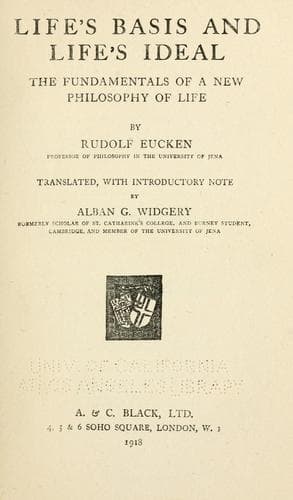
Life's Basis and Life's Ideal: The Fundamentals of a New Philosophy of LifeEucken, Rudolf
Philosophy
Life's Basis and Life's Ideal: The Fundamentals of a New Philosophy of Life
Eucken, Rudolf
Life; Ontology
In the life of the individual the moral judgment manifests its power in
affirmation as well as in negation. If it approves one's disposition and
conduct, it gives to life a greater stability and joyfulness; if it
condemns, then existence is paralysed by division. In this experience it
is implicitly assumed that the distinction of good and evil has its
source neither in the preferences of the human individual nor in those
of the human society; but that in this antithesis a new order that is
present only to the inner nature is revealed.
We see, therefore, that in contrast with its attachment to the external,
life attains an independent inwardness which we are compelled to
acknowledge, however mysterious the inward may at present be to us, and
however little we may be able to define its nature more closely. Earlier
in our investigation we were led to recognise a movement of life from
the narrowness of the individual to the comprehensiveness of the whole.
It is obvious that our two results are closely connected with each other
and refer to each other. For we attain a unity, as contrasted with the
juxtaposition of the elements of the visible world, only through a
powerful activity from within; but this activity cannot emerge unless
life forms a whole in contrast with its dissipation into disconnected
points.
These two developments are obviously sides of the same life--a life
which bears a totally different character from that of the psychical
life which forms a mere continuation of nature. Within the soul itself
there is a distinction between two levels, of which that other than
nature may in agreement with established usage be called "spiritual,"
however little may be implied by this expression; however mysterious,
indeed, the conception may for the present be. In contrast with the old,
this new level is unmistakably at a disadvantage. The old seems to
include the whole range of human existence; the new, on the other hand,
must toilsomely struggle for a place of some kind. Nevertheless, in
spite of its external insignificance, the spiritual gives birth to a
movement of no mean character; in face of all opposition it seeks to
form a centre of life of its own, and to make this the chief basis of
effort; it is to be found thus in the life of mankind as revealed in
history, and also in that of the individual. Within the conception of
culture we comprehend all achievements distinctive of man. But what is
culture if it does not assure to man a position independent of nature;
if it does not set up ideals which can arise only out of a new life?
Ultimately the chief motive-power of culture is the longing of mankind
for a new kind of being in contrast to that of nature. Culture
necessarily becomes superficial and empty when it directs human striving
to external objects and does not lead through all occupation with
externals to its own development and to the advance of its own being.
The work of culture is genuine and powerful only when man seeks in it
Public-domain text, read in full here on John Shaqi.
Reviews
Reviews
No reviews yet
Be the first to share your thoughts on this work.
Elsewhere in the archive
Join the Discussion
Join the discussion
Sign in to leave a comment or review.
Sign InorCreate an account