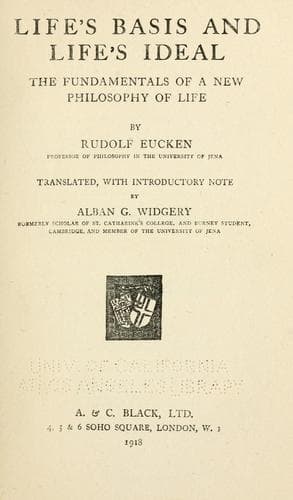
Life's Basis and Life's Ideal: The Fundamentals of a New Philosophy of LifeEucken, Rudolf
Philosophy
Life's Basis and Life's Ideal: The Fundamentals of a New Philosophy of Life
Eucken, Rudolf
Life; Ontology
The conclusion we are led to is that a new life distinct from that of
nature arises in our soul. With a great diversity of manifestations, it
surrounds us with an indisputable actuality; no one can fail to
recognise that something of importance, something distinctive comes to
pass in us. But as soon as we try to comprehend these manifestations as
a whole, and to ascertain the meaning of the whole, a difficult problem
arises. It is comparatively easy, however, to come to an understanding
as to the negative aspect of the matter. It is obvious that the new life
is not an embellishment or a continuation of nature; it would bring with
it something essentially new. Again, it is obvious that it is not a
product of a single psychical function, such as thought or feeling; it
would form a whole transcending the psychical functions, and from this
whole determine the form of each function distinctively. But what is
this new reality and this whole to which the course of the movement
trends? The more we reflect over the question the more strongly we feel
that it is a direction rather than a conclusion that is offered to us in
this matter; something higher, something inward and so on is to evolve,
but what is embedded in the inward and in what this supremacy is based
is at present not apparent. Further, every attempt at a more definite
orientation at once reveals to us a wide gulf, indeed a harsh
contradiction, between the content of that which is sought and the form
of existence from which it is sought. The chief impulse of the spiritual
life is that it wills to liberate us from the merely human; to give us a
share in the life of the whole; to remove us from a happening between
things to their fundamental happening. Seen from within, the history of
humanity is primarily an increasing deliverance of life from bondage to
the narrowly human, an emergence of something more than human, and an
attempt to shape our life from the point of view of this: it is an
increasing conflict of man with himself. At the same time, however, it
is a taking up of the whole into himself; since man in all his planning
and striving is related to the whole, it seems to him that his own
nature must remain alien to himself if the whole does not disclose
itself to him and allow him to participate in a life which has its
source in ultimate depths; if in the life of the whole he does not find
a purer and a more genuine self. The idea of truth impels us beyond all
the limitations to which a particular being is subject, beyond all
communication of things from without. There must be nothing between us
and reality; the inner life of reality must become ours, and thus our
life will emerge for the first time from a shadowy existence to full
reality, from the narrowness of the mere individual to the
comprehensiveness of infinity. The idea of the good makes similar
demands. To the spiritual movement, the advancement of merely human
well-being is far too mean an aim. This movement makes us clearly
Public-domain text, read in full here on John Shaqi.
Reviews
Reviews
No reviews yet
Be the first to share your thoughts on this work.
Elsewhere in the archive
Join the Discussion
Join the discussion
Sign in to leave a comment or review.
Sign InorCreate an account