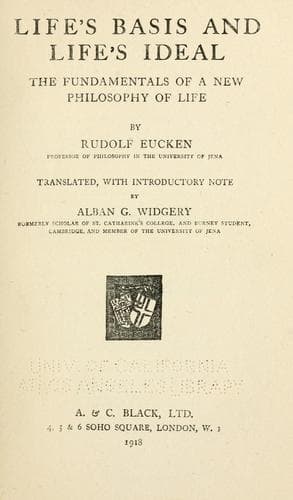
Life's Basis and Life's Ideal: The Fundamentals of a New Philosophy of LifeEucken, Rudolf
Philosophy
Life's Basis and Life's Ideal: The Fundamentals of a New Philosophy of Life
Eucken, Rudolf
Life; Ontology
If the acknowledgment of an independent spirituality thus alters the
view of reality as a whole, and in particular of man, we are faced with
the question whether we may not attain a new synthesis through this
spirituality, and whether it does not begin a characteristic formation
of our world. Our treatment of the philosophies of life of the present
day makes it possible for us to approach this question with definite
demands. We saw life branch off in different movements, each of which
took up into itself a wealth of fact; but we found none of them strong
enough to absorb the others into itself, or even able to estimate them.
If life is not finally to fall into dissolution, it needs, in contrast
to these movements, one more universal in character, and this can be
more than a weak compromise only when there is a still more fundamental
relation of life than that which the developments that we have
considered proffered. In that case the more original basal relation
ought to be able to manifest itself as a presupposition of those
developments; it should make intelligible how divisions can originate in
the condition of man; in particular it should illuminate the opposition
between the idealistic and the naturalistic systems of life--an
opposition which, like a deep gulf, divides the life of the present. In
short, it should depend upon whether the change that results with the
acknowledgment of the independence of the spiritual life makes it
possible for us permanently to transcend those oppositions and to work
towards their reconciliation. But we ought then to see that, with its
universality, the system of life striven for does not fall into a state
vague and lacking in character. Through its whole being, in affirmation
and in negation, the system of life must definitely express itself; it
must synthesise and differentiate, elevate and exclude. But it will be
able to do this only if it produces a new kind of life-process and a new
web of life: only thus can essentially new evaluations and tasks, new
experiences and genuine developments, originate; only thus can life as a
whole be definitely raised. Of course, this new cannot signify something
that has just been discovered and that has arisen suddenly. How could it
be a truth which gives to us security, and how could it dominate our
life, if it is not rooted in our being, and if it had not exerted an
influence at all times? But it makes a great difference whether the new
has been concealed, obscure and against the tendency of our own
activity; or whether it is taken up fully in our own self-determining
activity and thereby essentially advanced. If, on the one hand, the new
must be something old, on the other hand the old must become something
new if it is to liberate, strengthen, and elevate our life where its
needs are so urgent.
(c) _The Spiritual Basis of the System of Life_
Public-domain text, read in full here on John Shaqi.
Reviews
Reviews
No reviews yet
Be the first to share your thoughts on this work.
Elsewhere in the archive
Join the Discussion
Join the discussion
Sign in to leave a comment or review.
Sign InorCreate an account