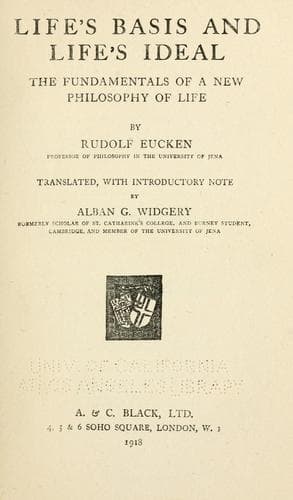
Life's Basis and Life's Ideal: The Fundamentals of a New Philosophy of LifeEucken, Rudolf
Philosophy
Life's Basis and Life's Ideal: The Fundamentals of a New Philosophy of Life
Eucken, Rudolf
Life; Ontology
If our human reflection often advances from the indefinite to the
definite, from the abstract to the concrete, this does not involve that
the latter is originated from the former: the advance could not be
achieved unless that which comes at the end was operative from the
beginning as its basis and presupposition.
If a self-conscious life unfolds itself with an increasing content
through all departments and activities of life, then these departments
will have their meaning and their value primarily in that which they
accomplish for the further development of that life, and in the
particular tendencies that they add to it: this yields a treatment and a
standard of value different from those which we are led to if we make
the psychical states of the individual our starting-point. The treatment
of religion, for example, as a mere occurrence of an unrestrained
psychical life may understand by religion a particular agitation of this
or that psychical function; but with this we do not obtain a spiritual
content. Again, it is not evident how a world of thought formed from
such an individual psychical life could acquire an independence of man,
and lift him above the position in which it finds him. The problem of
religion attains quite a different basis if the spiritual movements and
contents which emerge with it are emphasised; with this it develops and
discloses the reality of the spiritual life more deeply. Then through it
we may discover and win something that alters the condition of life,
transcends the immediate life of the soul, and is able to exert an
elevating influence upon man. The value and the truth of a particular
religion will be judged in the first place by the nature of the
spiritual substance that it offers, and the degree in which, in its
advance, it is able to join itself to the movement of life as a whole
and to guide it further. A great divergence is possible between this
spiritual substance and the movement and passion that call forth a
religion on the basis of humanity: the real is, in human relations, by
no means without further consideration to be regarded as rational.
The case of the other departments of life is the same as that of
religion: the character and the value of all achievement depend entirely
upon the range and the kind of substantial spirituality that they
evolve. The same is valid of whole epochs and cultures, of peoples and
individuals. The exertion of the greatest energy upon externals and the
most revolutionary transformation of human conditions cannot protect us
from becoming inwardly destitute, or lead us beyond mere appearance to
genuine reality. On the contrary, the experience of history shows often
enough that spiritual revivals have been accompanied in their origin and
growth by manifestations externally insignificant; and that something
which struggles against the broad stream of human life fundamentally
changes the standards and values of our existence.
Public-domain text, read in full here on John Shaqi.
Reviews
Reviews
No reviews yet
Be the first to share your thoughts on this work.
Elsewhere in the archive
Join the Discussion
Join the discussion
Sign in to leave a comment or review.
Sign InorCreate an account