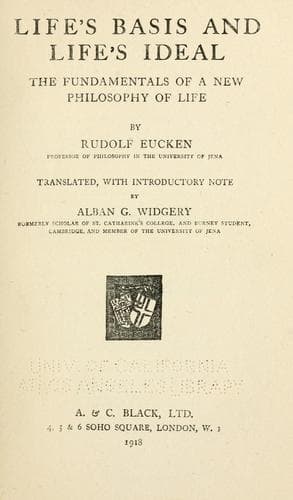
Life's Basis and Life's Ideal: The Fundamentals of a New Philosophy of LifeEucken, Rudolf
Philosophy
Life's Basis and Life's Ideal: The Fundamentals of a New Philosophy of Life
Eucken, Rudolf
Life; Ontology
Attempts to attribute the responsibility of all limitation to man and
his will, to find the root of all evil in the moral failings of
humanity, have not been wanting. Universal religions have given these
attempts an embodiment. It has seemed as though the harmony of reality
is only disturbed by man, and as though his moral restoration were the
only thing necessary to lead to all good. To be sure, such a way of
thinking manifests a disposition of great seriousness, and it may appeal
to the fact that the perplexity of our existence is nowhere more real
than in reference to the ethical problem. Still, there is no possibility
of doubt for the man of the Modern Age that this conception is too
narrow; that it not only contradicts indisputable impressions and
experiences, but also takes the question much too subjectively and too
anthropomorphically, and thus falls into the danger of doing harm to the
cause that it wishes to serve. It is not simply our disposition, it is
our being as a whole and the circumstances that we are in, which
obstinately oppose the emergence and the development of an independent
spiritual world. It is the most elementary forms of life themselves that
prevent the elevation of our existence to the level of a genuine
spiritual life. We cannot blind ourselves to the fact that the greater
part of our life is bound up with a form of existence in which it is not
able to embrace the spiritual life. Any kind of appropriation of the
spiritual--if it is at all possible--can be effected therefore only in
opposition to that form of existence. In genuine spiritual life all
movement should proceed from the whole and should be sustained by the
whole, even when it is concentrated in the individual departments and
tendencies. Human existence presents the spectacle of individuals ranged
side by side; and if a movement to overcome the original inertia is to
begin at all, their impulses, their desire for happiness, and their
conflicts are necessary. The spiritual life knows no limits; it works
and creates from the infinite whole: the individual is narrowly limited,
and with all his activity and work constitutes but a tiny point in the
infinite whole. The spiritual life presents its content as transcending
time; even if for us it is only gradually revealed, time is in this a
mere means to the presentation of an eternal and immutable truth: man,
however, drifts with time; is dependent upon the momentary situation,
and experiences himself in an incessant change: how can he comprehend
the eternal? Spiritual creation is effected in the transcending of the
antithesis of subject and object: human endeavour is conditioned by this
antithesis. The former with its self-determining activity overcomes from
within the attachment to sense: man even in the highest flight of his
endeavour cannot withdraw himself from it. From the altitudes occupied
by the spiritual life submission to the impulses and the goods of sense
Public-domain text, read in full here on John Shaqi.
Reviews
Reviews
No reviews yet
Be the first to share your thoughts on this work.
Elsewhere in the archive
Join the Discussion
Join the discussion
Sign in to leave a comment or review.
Sign InorCreate an account