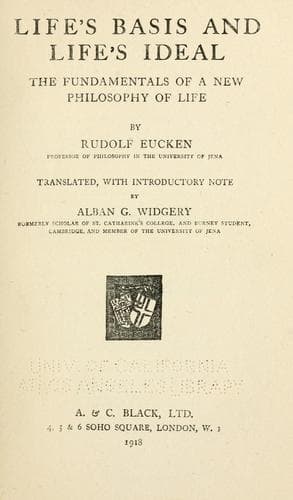
Life's Basis and Life's Ideal: The Fundamentals of a New Philosophy of LifeEucken, Rudolf
Philosophy
Life's Basis and Life's Ideal: The Fundamentals of a New Philosophy of Life
Eucken, Rudolf
Life; Ontology
the glossing over, the real state of things must ultimately assert
itself: pessimism must then be the last word, and the belief in a
rationality in human existence must finally be given up. The faith in
the greatness of the empirical man is, indeed, of all faiths the
boldest. For, if the other faiths proclaim a new reality in contrast
with the world of sense, they have the possibility of one in an
invisible world. In the case that we are considering, however,
experience itself must offer more than mere experience; we must not only
be certain of a thing that we do not see, but that which we do not see
must coincide with that which exists immediately before us. Such a
position is no longer a faith, but a gross contradiction, a complete
absurdity.
(e) _Results and Prospects_
The immediate experience of man may by no means be rejected as a whole
on this account; if it were, spiritual work itself would degenerate and
lack content. However, we only need to take up into a whole the
impressions and experiences which each in his sphere acknowledges to be
indisputable, and it will be clear that a movement toward spiritual
independence can never proceed from such a pitiable state of confusion
as that which is thereby seen to exist. It is essential that the
movement toward spiritual independence have an independent starting
point, and proceed on its own course. Only then is it able to select and
appropriate the spirituality that exists in those confused experiences,
and at the same time purify and strengthen it. We may most decisively
reject all presumption to sovereignty on the part of the human realm;
nevertheless, for the construction of a spiritual world that realm
cannot be dispensed with. For this construction is not peacefully and
securely accomplished through the self-development of a spiritual power
placed in us, as was supposed by those who attempted to represent
reality as a whole as a cosmic process of thought. If through the
joyfulness of its faith and the definiteness of its undertaking this
attempt captivated the minds of men for a time, at last it was
frustrated by the fact that we men do not find ourselves immediately in
the atmosphere of reason, but have first through toil to raise ourselves
into it; that we have to do not with absolute spiritual life, but with
spiritual life under the conditions and limitations of human existence.
Thus, in the first place an independent spiritual life, a universal
self-consciousness, must work in us and be changed in our activity; and
this can be accomplished only by a revolutionary transformation of life
as we immediately experience it; only by the attainment of a new point
of view. But if at this point of view certain fundamentals of a new
world become evident, they are as yet only fundamentals, and, without
the help of a world of immediate existence, without recourse to the
movements and experiences of human life, they cannot be completely
developed and embodied.
Public-domain text, read in full here on John Shaqi.
Reviews
Reviews
No reviews yet
Be the first to share your thoughts on this work.
Elsewhere in the archive
Join the Discussion
Join the discussion
Sign in to leave a comment or review.
Sign InorCreate an account