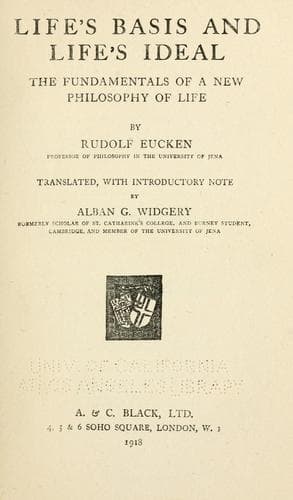
Life's Basis and Life's Ideal: The Fundamentals of a New Philosophy of LifeEucken, Rudolf
Philosophy
Life's Basis and Life's Ideal: The Fundamentals of a New Philosophy of Life
Eucken, Rudolf
Life; Ontology
and subjectivity of man, and this can be accomplished only through the
disclosure of new forms and contents of life. Accordingly attention must
in the first place be centred upon the pointing out of such new forms
and contents.
The union of the spiritual life with man, its being firmly rooted in
him, is seen to be at the same time something old and something
new--something old in so far as it must have been existent and in some
way effective from the beginning, something new in so far as its
distinct emergence and its transition to a state of self-determining
activity must alter the condition of things essentially; in fact, must
turn life as a whole into a problem. Where the reality of man is
reduced, as by Hegel, solely to an unfolding of thought and cognition,
the present may find its most important task in the complete
clarification and appropriation of the past; life comes to complete
satisfaction in the drawing of historical achievement to itself. Where
it is a question of the building up of a reality based on self-conscious
and self-determining activity, when we ourselves share in such activity,
we must find ourselves in an essentially different relation to things;
and with all the connection with the past, life will press forward,
changing and elevating in contrast with the whole past.
* * * * *
A contact, indeed a union, must therefore be established between the
independent spiritual world--which in some way must be operative in
us--and the activity of our own which struggles upward; and, through the
gain of such a contact, that world must be led to more complete
organisation, and that which strives upward made secure, unified, and
advanced. In this it is essential that the movements and the demands
which the fundamental idea of the spiritual life contains be present to
our minds. The spiritual life appears, so we saw reason to believe, in
the first place, to be something essentially new in contrast to the life
of nature. The spiritual life is not the product of a gradual
development from the life of nature, but has an independent origin, and
evolves new powers and standards: new beginnings must, therefore, be
recognisable in us if the spiritual life is to become our life. The new,
however, manifested a development of the inner life to independence in
opposition to its state of subjection at the level of nature, and so
thus in man also the inner life must in some way come to itself and
attain to freedom. We saw, further, that this development to
independence cannot be brought about through new achievements in a given
world, but that it needs the building up of a new world--a new basis for
life: it extends even to the final basal forms; not any kind of activity
could suffice, but a being within the activity, or, rather, a division
of activity into something sustaining and comprehending on the one hand,
and something demonstrating and producing on the other, is necessary. It
Public-domain text, read in full here on John Shaqi.
Reviews
Reviews
No reviews yet
Be the first to share your thoughts on this work.
Elsewhere in the archive
Join the Discussion
Join the discussion
Sign in to leave a comment or review.
Sign InorCreate an account