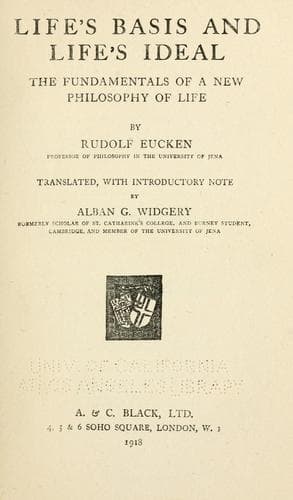
Life's Basis and Life's Ideal: The Fundamentals of a New Philosophy of LifeEucken, Rudolf
Philosophy
Life's Basis and Life's Ideal: The Fundamentals of a New Philosophy of Life
Eucken, Rudolf
Life; Ontology
This is in particular clearly the case in the idea of duty, the
elucidation of the inner meaning of which is Kant's greatest and most
enduring service. A duty is always a command; it presents itself as
independent of all caprice. At the same time, however, it can never be
forced upon us by an external power; it needs our own assent and
acknowledgment. Our own volition and being must operate in it, and, in
this, being must present itself otherwise than it appears to be at the
first glance. We must bear and maintain within us a new world; in
submission to its orders we must assert and develop ourselves. In this
manner alone can we explain the joyfulness which accompanies all genuine
performance of duty, and without which duty is no more than a task
forced upon us. How much power duty, and the norms in general, may
acquire in the greater part of human life is a question in itself; but
they could not exist for us even as ideas and possibilities if they were
not in some way based in our own being. However, as they show this being
in a new light, it follows that they must themselves gain in clearness
and in power and become more closely unified if they are understood and
treated as developments and modes of self-preservation of our own life.
It is with regard to content as well as to form that beginnings of a new
life appear. At the level of nature only that which serves the
self-preservation and the advancement of the life of the individual
being is estimated as a good; all that is involved in this may be
comprehended under the conception of utility. But notwithstanding its
great power over man the consideration of utility does not form the only
motive of his life. For a detailed treatment of this matter we may refer
to what was said in the discussion of "The Growth of Man beyond Nature."
At present we are concerned especially with the view that the new that
appears in us should be acknowledged to be the manifestation of a new
world and the expression of our real being. In the growing of man beyond
nature negation usually preponderates; he must limit the impulses of
his natural _ego_, acknowledge and respect the rights of others, be
ready to subordinate and sacrifice himself. It is for the most part not
evident what can commend such a negation to him and give it power over
him; and an impulse aroused to clear consciousness and strong desire
may, therefore, feel this entire connection with a new world to be an
unwarrantable limitation, and reject it as a violent intimidation and a
degradation of life. The matter is seen in its right light only when
negation is regarded as the reverse side of affirmation, and even then
only if the winning of a new life and being is acknowledged in this
affirmation. The positive impulse of self-preservation is indispensable
to complete vital-energy, but mere self-assertion on the part of an
individual in opposition to others does not constitute a genuine self; a
Public-domain text, read in full here on John Shaqi.
Reviews
Reviews
No reviews yet
Be the first to share your thoughts on this work.
Elsewhere in the archive
Join the Discussion
Join the discussion
Sign in to leave a comment or review.
Sign InorCreate an account