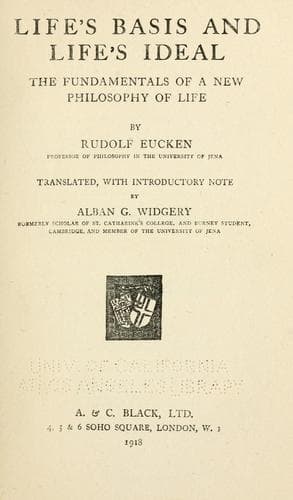
Life's Basis and Life's Ideal: The Fundamentals of a New Philosophy of LifeEucken, Rudolf
Philosophy
Life's Basis and Life's Ideal: The Fundamentals of a New Philosophy of Life
Eucken, Rudolf
Life; Ontology
An attempt to unite our life with the whole appears in the first place
in thought, in its work of obtaining knowledge. This emergence of
thought involves a transformation of life that could never be occasioned
by mere man, but can be understood only as the revelation of a new stage
of universal life. In thought, the intellect, otherwise bound to the
mechanism of the sequence of presentations, attains an independence. It
places itself in a position independent of the world, and seeks to
comprehend it as a whole, to appropriate it as a whole. The primary
connection with things is dissolved, to become established anew upon a
higher level and with an important transformation of its nature; through
the deviation a real appropriation is achieved. All this is incomparably
more than a merely becoming conscious of a given world, which is an
experience that could arise in some way at isolated points; thought
contains a development of the world which ultimately can proceed only
from the power of the world itself. How can the individual matter be
elucidated if the whole remain obscure? How can the desire for
enlightenment obtain such a power over man, and assert itself in him in
opposition to the interests of his physical self-preservation, if a
universal movement were not operative in him? Man does not elucidate the
world, but the world elucidates itself within him. What is thus reached
is valid not for him alone, but universally; the development of this
universal movement of thought enables him to win a closer relation to
the world, a life embracing the world.
Public-domain text, read in full here on John Shaqi.
Reviews
Reviews
No reviews yet
Be the first to share your thoughts on this work.
Elsewhere in the archive
Join the Discussion
Join the discussion
Sign in to leave a comment or review.
Sign InorCreate an account