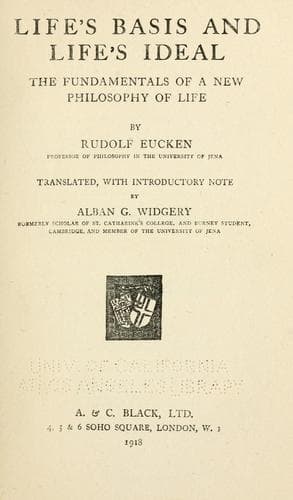
Life's Basis and Life's Ideal: The Fundamentals of a New Philosophy of LifeEucken, Rudolf
Philosophy
Life's Basis and Life's Ideal: The Fundamentals of a New Philosophy of Life
Eucken, Rudolf
Life; Ontology
The same thing is valid with regard to the things of value in life; in
these, also, sense and spirit are not simply combined; but something of
sense becomes a spiritual good only so far as it serves the spiritual
life in some way; it cannot do this, however, without itself undergoing
a transformation. This is to be seen nowhere more clearly than in
economics. Money and estate had at all times a value for
self-preservation and enjoyment, but in the doctrine of economics and
political economy they could obtain acknowledgment only after a power to
advance the spiritual life had been recognised in them. As culture in
the ancient world had not yet reached this point of view, it branded all
endeavour after material wealth as inferior, and as far as possible
checked such endeavour. Only since the Modern Age has recognised in
money and estate an indispensable means of gaining control over the
surrounding world and of increasing human power have they secured a
place within the spiritual life, and as a result of this have become
more highly estimated. At the same time, however, they have been changed
inwardly in the process, since that which they achieve, not towards
ostentatious display and enjoyment, but towards the increase of human
power over things has become the chief matter.
As in this way the content and the value of that which is offered by the
world of sense shows its dependence upon the condition of the spiritual
life, so in science also a similar relation between experience and the
spiritual life is found. Science appeals to experience with particular
zeal, more especially after it has first accomplished far-reaching
changes in its own thought constructions; only then does experience give
anything new to knowledge and exhibit a greater depth. Experience can
answer only in the measure in which it is questioned; the question,
however, varies according to the stage of development of the spiritual
life.
Such a view fully appreciates the significance of life-work, and must
strive energetically to gain its acknowledgment. This work is not a
carrying out of a complete scheme in a given condition of things, an
application of firmly rooted principles to particular cases, but a
self-realisation and self-perfecting of the spiritual life which builds
up a self-conscious reality. In this our life is not divided between two
different realms, but, in a comprehensive spiritual world, different
stages of reality meet together, which must be brought into relation and
developed. To be sure, the world of sense retains a certain
independence; it resists a complete transformation into spiritual
magnitudes, and our life, therefore, retains a certain restriction and
impenetrability. But the self-consciousness of the spirit becomes more
and more the chief basis and sphere of life: this self-consciousness
continually takes up more into itself; it makes the world that was to us
at first primary, indeed the only world, more and more secondary and
subordinate.
Public-domain text, read in full here on John Shaqi.
Reviews
Reviews
No reviews yet
Be the first to share your thoughts on this work.
Elsewhere in the archive
Join the Discussion
Join the discussion
Sign in to leave a comment or review.
Sign InorCreate an account