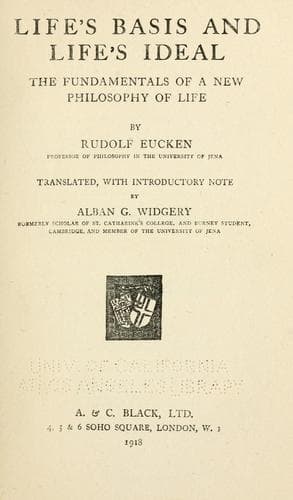
Life's Basis and Life's Ideal: The Fundamentals of a New Philosophy of LifeEucken, Rudolf
Philosophy
Life's Basis and Life's Ideal: The Fundamentals of a New Philosophy of Life
Eucken, Rudolf
Life; Ontology
Life in the individual must have roots deeper than the immediate
psychical life; for psychical life cannot itself produce and make clear
that which occurs in it, for this reason at least, that it involves the
antithesis of individual and environment, of subject and object, beyond
which spiritual creation results. The spiritual impulse that the
immediate life of the soul manifests can be based only upon deeper
realities and more comprehensive relations. And so a _noölogical_
treatment is to be distinguished from the psychological, not in order to
displace or limit the latter, but rather to complete it; and it is a
problem to show the point of transition in the immediate life of the
soul. The significance of the individual life, as far as content is
concerned, will depend upon whether an independent spirituality arises
within it, and constitutes it a distinctive life-centre. According to
the new standards a free spiritual activity does not suffice, however
extended it may be, and however sustained by subjective emotion. For all
such activity may be without spiritual substance, and in spite of all
external results the life that is nothing but this activity may remain
spiritually destitute: how shallow many individuals are whose
achievements deserve and obtain the highest appreciation! The inwardness
that the spiritual life requires is not simply a reflex of work in the
soul--from that little is gained--but the forming of a characteristic
spiritual self-consciousness that lifts us above all mere achievement,
and also by giving to activity a soul first makes it complete.
We have often seen how the acknowledgment of an independent spiritual
life forces us to make a sharper distinction between human history and
human society and all merely natural history and merely natural
co-existence of men. At the same time, in that which is called history
and society, a distinction between an esoteric and an exoteric kind is
also required. The value of individual epochs and of history as a whole
depends upon the spiritual substance that grows up in them; everything
else, to whatever extent it may, with commotion and external result,
assume the air of being the chief thing, is only environment or
supplement. Similarly, in the case of society, the spiritual content, if
it has one at all, and human fortune and conduct must become more
distinctly separated. There is far less genuine history and society than
is usually assumed; but this little signifies incomparably more than
both would imply without the spiritual life.
Public-domain text, read in full here on John Shaqi.
Reviews
Reviews
No reviews yet
Be the first to share your thoughts on this work.
Elsewhere in the archive
Join the Discussion
Join the discussion
Sign in to leave a comment or review.
Sign InorCreate an account