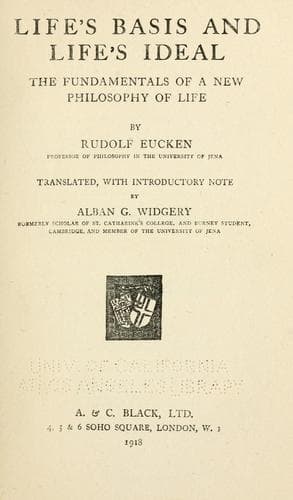
Life's Basis and Life's Ideal: The Fundamentals of a New Philosophy of LifeEucken, Rudolf
Philosophy
Life's Basis and Life's Ideal: The Fundamentals of a New Philosophy of Life
Eucken, Rudolf
Life; Ontology
Lastly, it should not be forgotten that it is modern science, especially
in its latest phases, with its destruction of the supposed self-evidence
of the sense impression of nature, that has placed the relation of
nature to the spiritual life in a more favourable light than it was
placed by the dogmatic mechanistic theory, which in earlier times seemed
to be the ultimate solution of the problem of their relation. Nature has
again become far more of a problem to us, and we recognise that our
conception of it is a work of the spirit. The old facts of the
connection and interaction of phenomena, of the conformity to law on the
part of occurrences, of the developments of form, and of a progress to
even more artistic complexes and ever finer organisation, once more make
us feel, and far more keenly than before, that they involve difficult
problems. It is more clearly evident to us than it was formerly that
every attempt to make these facts intelligible is made by the spiritual
life and by analogy with the spiritual life. If in such analogy we do
not go beyond symbols, yet the symbols themselves betray a depth and a
secret of reality. At the present time when scientific work is at its
highest stage of development, the shallowness and the rashness of a
radical negation are distinctly recognised.
It is true that for the particular life-problem that we are considering
we have not yet gained much from this recognition; to perceive the
impossibility of an absolute negation does not in itself imply the
victory of a joyful affirmation. For all the perplexities that
previously occupied us still remain, as do the limitation and the
curtailment of the spiritual life which proceeded from these
perplexities; the whole movement also remains in its state of
stagnation. As certainly as on the one hand there is too much of the
spiritual life presented to us to allow of negation, so on the other it
is by no means sufficient for the removal of all doubt.
Mere research can tolerate a state of hesitation between affirmation and
negation; it must often refrain from a decision in the case of special
problems. Life, however, cannot endure any such intermediary position;
for life, such hesitation in arriving at a decision must result in
complete stagnation, and this would help the negation to victory. If
life is faced with an "either--or" the affirmation has a prospect of
victory only if the situation previously described may be in some way
transformed in its favour. This cannot come to pass unless the spiritual
movement can transcend the limitations which appear in human life, and
unless a further development can proceed out of the limitations
themselves. Only such an advance can help the endangered affirmation to
victory. But whether the spiritual movement does transcend these
limitations, not a logical consideration of concepts but only the
experience of life will decide; let us enquire therefore whether life
offers what we seek.
(c) THE VICTORY
Public-domain text, read in full here on John Shaqi.
Reviews
Reviews
No reviews yet
Be the first to share your thoughts on this work.
Elsewhere in the archive
Join the Discussion
Join the discussion
Sign in to leave a comment or review.
Sign InorCreate an account