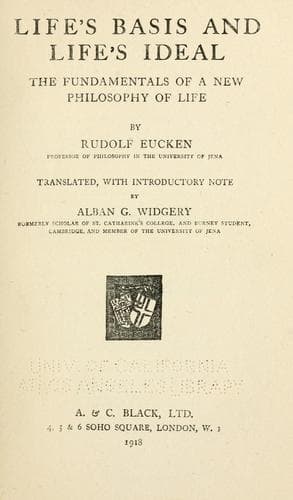
Life's Basis and Life's Ideal: The Fundamentals of a New Philosophy of LifeEucken, Rudolf
Philosophy
Life's Basis and Life's Ideal: The Fundamentals of a New Philosophy of Life
Eucken, Rudolf
Life; Ontology
The essence of religion is still less affected by the charge that modern
natural science in conceiving of the spatial world as infinite leaves no
room for a visible heaven. For, to take such a criticism seriously, we
must not only think of religion as at a primitive stage which, in the
development of its spiritual content, it has overstepped, but we must
also completely ignore the fundamental revolution that modern philosophy
and the whole tendency of modern thought have accomplished in the
representation of the visible world. Modern thought has destroyed the
self-evidence that the naïve man attributed to that representation, by
the experience and the proof that the visible world around us does not
come to us completely as we represent it, but that we form the
representation from our point of view, and under the conditions of our
spiritual nature. Our own activity is embodied in the representation;
and it will depend upon the value of this activity how far the
representation may be accepted as reality as a whole and the ultimate
and absolute world. Now, as in the visible world the spiritual life is
always bound up with something alien and which cannot be completely
transformed by the activity of that life, so every assertion of an
independent spiritual life is a protest against the view that the world
of sense is the only world. But in that, unless the spiritual life is
independent, there is neither science nor culture, the priority of a
world other than that of sense cannot be in any way a matter of doubt to
philosophy.
But a world other than the world of sense is by no means the
transcendent world of religion; such a world as the latter could be
reached only by a continuation of the life-process beyond the position
yet attained; the course of our investigation, however, has left no
uncertainty concerning the direction in which such a world is to be
sought. We saw that the spiritual life could not acquire an independence
without becoming a universal life: only the immediate presence of this
universal life at the individual point arouses and preserves a spiritual
life in it. In spite of this immediate presence of the whole, the life
of man receives its more detailed organisation and development from his
relation to the environment and in the building up of a world; the unity
that exists in the whole reveals itself at first only in relation to the
multiplicity. There is, therefore, still the possibility that a new and
characteristic life should evolve out of an exclusive relation to the
whole; such a life, in contrast to that building up of a world, would
bear a world-transcendent character. This possibility constitutes the
only way of advancing beyond the position hitherto reached.
Public-domain text, read in full here on John Shaqi.
Reviews
Reviews
No reviews yet
Be the first to share your thoughts on this work.
Elsewhere in the archive
Join the Discussion
Join the discussion
Sign in to leave a comment or review.
Sign InorCreate an account