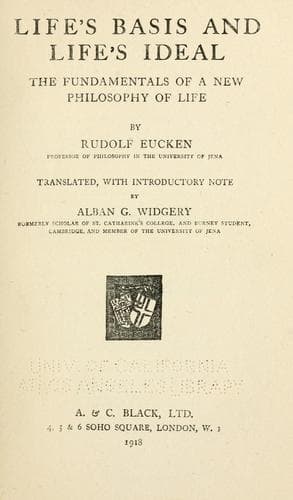
Life's Basis and Life's Ideal: The Fundamentals of a New Philosophy of LifeEucken, Rudolf
Philosophy
Life's Basis and Life's Ideal: The Fundamentals of a New Philosophy of Life
Eucken, Rudolf
Life; Ontology
The spiritual life in man could have no hope of acquiring truth if it
were not rooted in a life which transcends all error and which in some
way imparts to us this transcendence. If the spiritual life in man did
not know of certain truth sustained at one innermost point, a truth that
exerts a directing power on all human undertaking, and prevents it from
becoming fixed in error, man would lose all confidence in truth in face
of the obscurities and errors of life as they are shown by the work of
culture. Further, for the maintenance of the spiritual life, the
preservation of spontaneity, a possibility of overcoming all restriction
by nature and of defying destiny is absolutely necessary. But in work in
the world this spontaneity is subject to the most severe limitations;
the power of fate surrounds man on all sides: in the natural course of
things even his own work becomes a rigid destiny to him, and chains him
with inexorable necessity. As in the case of the individual, so also in
that of humanity as a whole, life is a gradual narrowing, an ever
further exclusion of original possibilities; and this tendency is
continually felt as an increasing oppression in its opposition to the
freedom of the will and an independent present. How may the spiritual
life be prevented from growing feeble and senile, if new pure beginnings
cannot be produced from a fundamental relation transcending the relation
with the world, if from this fundamental relation a spontaneous life
cannot spring up ever anew? The fact that humanity is able not only to
transform the nature of culture in its particular aspects, but also to
fall into error concerning culture as a whole, without surrendering
itself, is an indication that the life of humanity is not exhausted in
work in the world. The spiritual life must unite in an inner community
all who participate in it; and this is impossible unless the spiritual
life leads man to a point where all walls of partition and all
differences fall away. But spiritual work increases rather than
diminishes these differences; with culture the differentiation of men
also grows. We must sink ever deeper in such differentiation; lose more
and more the possibility of a mutual understanding, of a life and
feeling with one another and for one another, if this movement toward
differentiation does not come into contact with a transcendent power
that counteracts it, if some power does not unite us inwardly. What
other power could this be than the spiritual life itself, and how could
it effect this result otherwise than in the revelation of a
world-transcendent self-conscious life which thus presents itself as an
Absolute? For, then a removal of differences in negative and in positive
matters becomes possible: in negative matters so far as all achievements
in the human sphere, however distant they may be from one another,
appear equally inadequate when they are judged by the standard of an
Public-domain text, read in full here on John Shaqi.
Reviews
Reviews
No reviews yet
Be the first to share your thoughts on this work.
Elsewhere in the archive
Join the Discussion
Join the discussion
Sign in to leave a comment or review.
Sign InorCreate an account