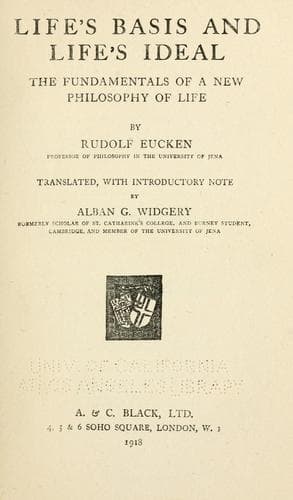
Life's Basis and Life's Ideal: The Fundamentals of a New Philosophy of LifeEucken, Rudolf
Philosophy
Life's Basis and Life's Ideal: The Fundamentals of a New Philosophy of Life
Eucken, Rudolf
Life; Ontology
It is this fact of transcendent spirituality that the religions take up
and develop, and seek to bring near to humanity. The doctrines they
contain are ultimately only the framework or the outward manifestation
of that world-transcendent inwardness; they desire to realise its power
of deliverance and elevation completely. They themselves have their
support and justification in this transcendent spiritual life, and the
precedence of one to the others will be judged by the degree to which in
affirmation and negation they develop this spiritual life in its
world-transcending sovereignty and in its world-penetrating power. From
the point of view of that life, religion as a whole must maintain its
truth and its indispensable nature: where that life is lacking, religion
is simply a delusion, a folly the absurdity of which is hardly
conceivable; but where it is developed religion must pass current as
that which, of all things, is the most certain, as the fundamental axiom
of the whole spiritual life. Between this "either--or" there is no
middle course; historical experience shows that religion has been to
men and ages either the most certain of all things or the one about
which there has been most dispute.
We can now return to the question that led us to this discussion, to the
question of the rationality of our reality. To be sure, even after the
further revelation of the spiritual life, the answer is not so easy as
the adherents of religion often think. For they often believe that with
the acknowledgment of a world-transcendent spirituality, its triumphant
manifestation within our world is immediately assured; and with this
conviction they attempt to present this world as a kingdom of justice,
even if not of love. But all endeavour, however energetic, and all
recourse to subtlety of thought, yield no satisfactory conclusion: at
most, the possibility is reached that that which seems irrational may
acquire some rationality in more comprehensive relations; but even if
that is so, we are not free from irrationality; and those mere
possibilities are far from being equal to counteracting the strong
impression of the reality of evil. Even religion, which would bring
about a transition to the better, is itself deeply involved in this
irrationality; a painful martyrdom has often been imposed upon its
heroes, and its form has continually degenerated in the course of
history through the influence of human error and passion. Since in the
latter the restriction is presented as an opposition to the divine, the
view of the world as it immediately appears is darkened rather than
illuminated.
Public-domain text, read in full here on John Shaqi.
Reviews
Reviews
No reviews yet
Be the first to share your thoughts on this work.
Elsewhere in the archive
Join the Discussion
Join the discussion
Sign in to leave a comment or review.
Sign InorCreate an account