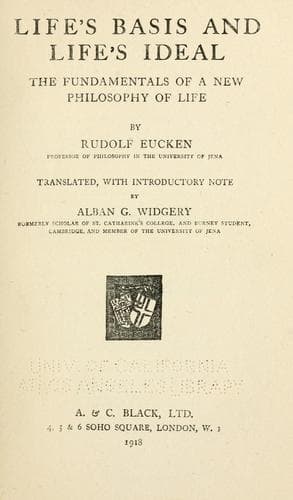
Life's Basis and Life's Ideal: The Fundamentals of a New Philosophy of LifeEucken, Rudolf
Philosophy
Life's Basis and Life's Ideal: The Fundamentals of a New Philosophy of Life
Eucken, Rudolf
Life; Ontology
If inwardness is so feeble and external relations so overwhelm us, life
necessarily receives its content from outside, and seems to be
determined essentially by that which happens around us. It is this that
lends so much power to-day to a superficial enlightenment that centres
in natural science, and expects life to be advanced without limit, and
man to be revived and ennobled, simply by reaching a more valid
representation of the environment. We do not ask here how far the
representations proposed overcome the difficulties of the older
representations, or whether new and more difficult problems do not arise
from the solutions offered; but we do ask whether life can obtain its
aim and content from outside, and whether it can be treated simply as an
addition to nature without degenerating inwardly, and losing all inner
motive. We ask what the theories based chiefly on externals make of man,
and what they achieve for his soul. We summon him to an examination, to
see whether the picture that is held up to him by these theories agrees
with what he longs for, and, by a compelling necessity of his being,
must long for.
To-day it will also be evident that the final decision does not rest
with the intellect, but with life as a whole. For, little as
intellectual achievement is absent from truth, the masses--and to the
masses belong those at the average level of all classes, higher as well
as lower--will always hold fast to the external impression. The advance
beyond this impression and the appreciation of the inner conditions of
knowledge will always remain a concern of the minority. There is,
however, a point where the problem becomes real to each individual, and
where each can offer his opinion: this is in reference to the question
of the happiness and the content of life. The more this question is
felt, the greater will be the thirst for a substantial truth in contrast
with the shadows of the Enlightenment; the more will the question
concerning the nature of life as a whole receive its due consideration,
and the perception of things externally will give place to a
comprehension of their inner reality. Only with such a revolution can
our life and we ourselves be transformed from a state of spiritual
destitution to one of independent energy; only thus can we discover the
wealth that is within us; only thus can culture, from being an
occupation with things, become a preservation and an unfolding of our
own selves; only thus can we strive for more simplicity in contrast to
the complexity that would otherwise be our condition; and only thus can
we wrest from what would otherwise be chaos, fundamentals and
tendencies. Our demand, therefore, that the starting-point should be the
life-process itself is in harmony with the innermost longing of the
time--even if this longing is often indefinite--after a deepening of
life and an attainment of its independence.
Public-domain text, read in full here on John Shaqi.
Reviews
Reviews
No reviews yet
Be the first to share your thoughts on this work.
Elsewhere in the archive
Join the Discussion
Join the discussion
Sign in to leave a comment or review.
Sign InorCreate an account