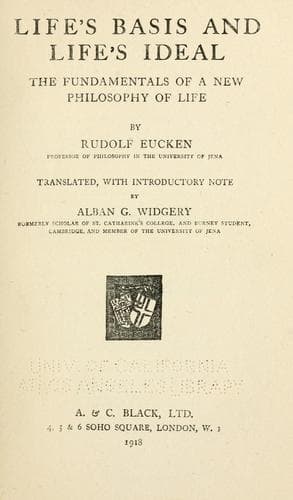
Life's Basis and Life's Ideal: The Fundamentals of a New Philosophy of LifeEucken, Rudolf
Philosophy
Life's Basis and Life's Ideal: The Fundamentals of a New Philosophy of Life
Eucken, Rudolf
Life; Ontology
If Christianity as a religion of redemption requires that we should tear
ourselves from the old world and aspire to a new one, this demand
receives a distinctive significance by the more detailed conception
which Christianity forms of it. As evil and that which is to be overcome
is regarded not, as among the Hindus, as mere appearance, but as moral
guilt, which disorganises the world, it is not the fundamental reality
of the world but a particular conception of it that is rejected; and so
there remains the possibility of life being given a positive character;
and in this the main thing is not intellectual enlightenment, but
radical moral renewal, an elevation into a world of love, grace, and
reverence. This view of the world makes it impossible to base life
simply upon affirmation or negation; but affirmation and negation must
be present within it, and thus life is given an inner comprehensiveness
and an inner movement which it would not otherwise possess. Christianity
included the innermost basis of human life in this movement and
transformation, since it not only regarded the divine as influencing the
human by individual manifestations of its power, but proclaimed a
complete union of both, and maintained this through its whole
development. A wearied and exhausted age may have formulated this
fundamental truth in the most unfortunate manner in the doctrine of the
divine humanity of Christ; nevertheless, the effectiveness of the truth
involved was not prevented by this. Only from the power of a conception
of a union of the divine and the human can religion acquire the
character of pure and complete inwardness, of a spiritual
self-consciousness: otherwise the relation of the divine and the human
remains a more or less external one. But this is not the place to trace
how the Christian type of life has been visibly embodied in the course
of history in the personality and the life of its founder, and in the
common labours of centuries, in which the Semitic and Germanic natures
have been harmonised, and great peoples and personalities have given
their best to the world: here we may only remark further that the whole
is not a work completed at one particular point in time, but a
continuous task of all ages; and that, in the fundamental life
transcending all mere time, a fixed standard is offered by which to test
the achievement of all particular ages, and to differentiate the results
of the work of history as far as they correspond with the fundamental
character of religion. Religion must maintain the fundamental character
of the life that it advocates, in face of all change in the state of
culture, just as decidedly as for its development in detail it remains
dependent upon the help of the work of culture.
Public-domain text, read in full here on John Shaqi.
Reviews
Reviews
No reviews yet
Be the first to share your thoughts on this work.
Elsewhere in the archive
Join the Discussion
Join the discussion
Sign in to leave a comment or review.
Sign InorCreate an account