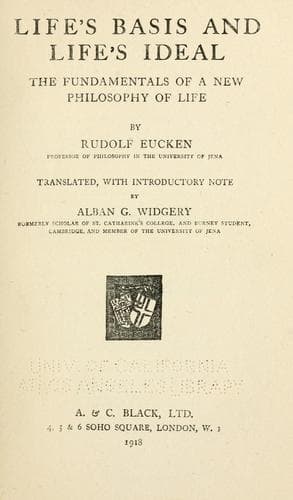
Life's Basis and Life's Ideal: The Fundamentals of a New Philosophy of LifeEucken, Rudolf
Philosophy
Life's Basis and Life's Ideal: The Fundamentals of a New Philosophy of Life
Eucken, Rudolf
Life; Ontology
Educational reform is the catchword, but we have no philosophy of
education that is based upon a securely established conviction
concerning life as a whole, and we trouble ourselves very little to
obtain one. We wish to improve education, and yet we have not come to an
understanding with regard to its ideals, its possibility, and its
conditions. Education must be fundamentally different in character,
according as man is regarded as a particular and exclusively individual
being, or as a being in whom a new and universal life seems to emerge;
according as he is only an elevated being of nature or in the highest
degree possible a spiritual being; according as the higher proceeds from
the lower gradually and surely after the manner of organic growth, or we
must find a new starting-point and accomplish a revolution. Further, an
individualistic training, as it dominated the classical systems of
pedagogy, is no longer sufficient; the relation to society must also be
fully appreciated, and be effective. But attention to this requirement
involves us in the danger of treating the problem of education too
externally, and of bringing all more or less to the same level; and this
danger must be overcome. Yet how can it be overcome, unless we possess
securely a depth, unless we acknowledge the presence of the infinite
within the human being, as it is comprehended in our conviction of the
spiritual life?
The form of instruction suffers from the ceaseless onflow of new
material, the constant increase in the number of claims. In itself each
single demand may be quite justifiable; but whether it is better than
the others can be decided only from an idea which governs the whole. If
no such idea exists, a gain in the individual departments may be a loss
to the whole; and an enrichment in one department may lead to a decline
of the whole. In face of that which has been handed down from the past
and that which arises in the present, it is difficult to come to a
balanced judgment; the parties may be right in their attacks one upon
another, but this does not imply that they are right in their own
assertions. The immediate impression tends to give the balance in favour
of the requirements of the present; from the point of view of the
immediate impression, all occupation with the past may appear to be a
flight from the living to the dead. The advocate of the claims of
history may reply to this that man as a spiritual being is not a child
of the mere moment, and that we concern ourselves with the past not on
account of what is transitory in it, but for its eternal content. But he
who thinks thus must throw the eternal content into relief and separate
it sharply from that which is simply temporal; he must establish a
relation between this content and his own life, and make that which is
externally alien his inward possession. This does indeed come to pass in
a few cases; but can we say that it comes to pass generally or
Public-domain text, read in full here on John Shaqi.
Reviews
Reviews
No reviews yet
Be the first to share your thoughts on this work.
Elsewhere in the archive
Join the Discussion
Join the discussion
Sign in to leave a comment or review.
Sign InorCreate an account