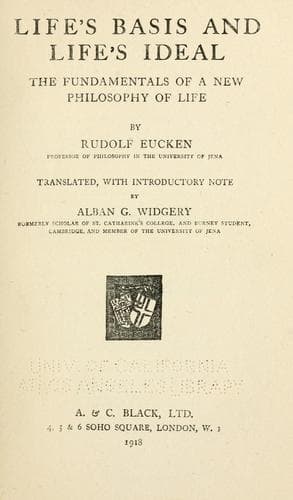
Life's Basis and Life's Ideal: The Fundamentals of a New Philosophy of LifeEucken, Rudolf
Philosophy
Life's Basis and Life's Ideal: The Fundamentals of a New Philosophy of Life
Eucken, Rudolf
Life; Ontology
If, therefore, this connection of philosophy with the life-process
signifies an old and indisputable truth, this truth is not sufficiently
acknowledged. Its adequate acknowledgment gives rise to a new situation;
indeed, it tends to the development of a new type of philosophy. With
the critical tendency of the Modern Age, this type shares the desire not
to surrender thought to a state of defencelessness in face of the stream
of appearances, but would primarily concentrate it in itself, and in an
inner independence find a standard for all further undertaking. But this
attainment of independence in thought is not accomplished by turning to
the mere subject, but to a central occurrence, transcending the
antithesis of subject and object. If thought cannot begin from such an
occurrence, and understand the movement of life as an unfolding and
perfecting of this comprehensive occurrence, then there is no truth for
man. Truth, as a relation of two series absolutely alien to each other,
is an absolutely nonsensical conception: truth must be immanent, in the
sense that one life embraces both subject and object, and that in the
movement of life there is as much a coming together of subject and
object as a coming together of activity from the centre and from the
circumference.
That in this we have to do with a peculiar formation of knowledge and
not with a merely formal modification is shown by the following
considerations. If thought, in the manner previously supposed, takes its
starting-point in a world existing independently of the subject, then in
order to subordinate reality spiritually thought will comprehend it in
the most general conceptions. Ultimately, the being of things will be
sought in formal ontological magnitudes, as, for example, in "pure
being." If the whole abundance of reality appears to be derived simply
from these general conceptions, it is in danger of being transformed
into nothing but schemes and shadows, and of losing all genuine life.
If, as opposed to this, the subject alone is taken as the
starting-point, then more life and more movement is indeed assured, and
a more varied prospect will be acquired, but there is no possibility of
distinguishing between that which is only contingent to the individual
and that which forms a common inner world; there is no possibility of a
rejection of the narrowly human, or even of extricating a realm of ideas
from the abundance of impressions: if in the former case knowledge lost
all content, in the present case it threatens to be completely
dissolved. If, further, on the one hand abstract universal conceptions,
and on the other the subjective states of individuals, form the stem of
knowledge, then neither in one nor in the other does the fullness of
spiritual reality attain its due--the reality that exists in the
building up of a genuine spiritual culture. But in the type of
philosophy advocated by us this is the chief thing; since in contrast to
Public-domain text, read in full here on John Shaqi.
Reviews
Reviews
No reviews yet
Be the first to share your thoughts on this work.
Elsewhere in the archive
Join the Discussion
Join the discussion
Sign in to leave a comment or review.
Sign InorCreate an account