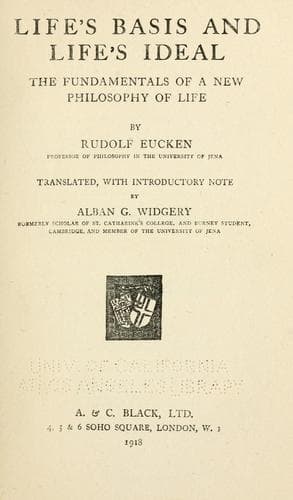
Life's Basis and Life's Ideal: The Fundamentals of a New Philosophy of LifeEucken, Rudolf
Philosophy
Life's Basis and Life's Ideal: The Fundamentals of a New Philosophy of Life
Eucken, Rudolf
Life; Ontology
marble which prescribe a certain direction to the work of the artist.
But these conditions must first be organised and by the complete
elevation of their nature spiritually unified; and this cannot be
achieved otherwise than through our own work, which through common
events and experiences follows its ideal. So far, therefore, national
character is not a gift of nature but a task which presents itself
distinctively to each people according to its nature and conditions. In
this matter a people must always in the first place realise a unity in
its own nature.
In the fulfilment of this task hardly any other people has had to
contend with keener opposition, both external and internal, than the
Germans. Our physical environment does not direct us so definitely into
distinctive paths as is the case with other peoples. But our inner
nature contains, before all else, harsh antitheses. Our strength lies
chiefly in arousing to life depths of the soul otherwise undreamt of.
Thus in music and in poetry we have been able to surpass all other
peoples; again, we have been able to give to religion a wonderful
inwardness, and in education to evolve the leading ideas. At the same
time, however, we are driven to the physical world to take possession of
and to shape things; we are not the Hindus of Europe, as other people
indeed previously called us. We came into history by achievements in
war, and the desire for conflict and victory has been maintained through
all the phases of our varied history. By the continued diligence of our
citizens in work we have subordinated the world around us to our aims;
our capacity for organisation has been most marked, as the present state
of industry and trade shows. However, not only have these movements
towards inwardness, and towards the world, a strong tendency to oppose
one another, but also, in contrast with these magnificent gifts, there
are many defects and tendencies that make the development of a powerful
and unified life exceedingly difficult. We show a want of form and
taste, a heaviness and formality, a tendency to occupation with detail
and, in general, with what is petty in life, and, as a result of this,
an uncultured "Philistinism" in all spheres of society, and along with
this the inclination on the part of individuals to insist on the
correctness of their positions, and thus to cause division; finally--and
this is the worst of all--much envy and jealousy. None of these features
can be denied. There is an infinite amount which must be altered and
overcome amongst us if we are to become what we are capable of becoming,
and if we are to reach the highest in our nature. The limitations that
have been brought about by our history, which on the whole has not been
a happy one, constitute an important determining factor in this matter.
The more problems we bear within us, the more possibilities of genuine
creation that exist within us, and the more we may be to humanity in the
Public-domain text, read in full here on John Shaqi.
Reviews
Reviews
No reviews yet
Be the first to share your thoughts on this work.
Elsewhere in the archive
Join the Discussion
Join the discussion
Sign in to leave a comment or review.
Sign InorCreate an account