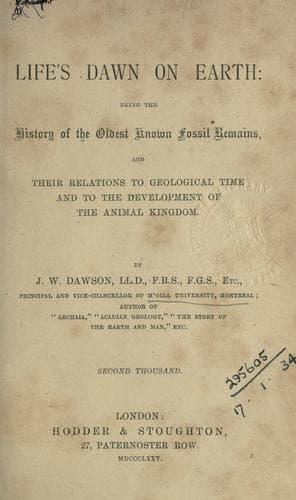
Life's Dawn on Earth: Being the history of the oldest known fossil remains, and their relations to geological time and to the development of the animal kingdomDawson, John William, Sir
History
Life's Dawn on Earth: Being the history of the oldest known fossil remains, and their relations to geological time and to the development of the animal kingdom
Dawson, John William, Sir
Life -- Origin; Paleontology -- Precambrian
"In the large quarry of Steinhag, from which I first obtained the
Eozoon, the enclosing rock is a grey hornblendic gneiss, which
sometimes passes into a hornblende-slate. The limestone is in many
places overlaid by a bed of hornblende-schist, sometimes five feet
in thickness, which separates it from the normal gneiss. In many
localities, a bed of serpentine, three or four feet thick, is
interposed between the limestone and the hornblende-schist; and in
some cases a zone, consisting chiefly of scapolite, crystalline and
almost compact, with an admixture however of hornblende and chlorite.
Below the serpentine band, the crystalline limestone appears divided
into distinct beds, and encloses various accidental minerals, among
which are reddish-white mica, chlorite, hornblende, tremolite,
chondrodite, rosellan, garnet, and scapolite, arranged in bands.
In several places the lime is mingled with serpentine, grains or
portions of which, often of the size of peas, are scattered through
the limestone with apparent irregularity, giving rise to a beautiful
variety of ophicalcite or serpentine-marble. These portions, which are
enclosed in the limestone destitute of serpentine, always present a
rounded outline. In one instance there appears, in a high naked wall
of limestone without serpentine, the outline of a mass of ophicalcite,
about sixteen feet long and twenty-five feet high, which, rising from
a broad base, ends in a point, and is separated from the enclosing
limestone by an undulating but clearly defined margin, as already well
described by Wineberger. This mass of ophicalcite recalls vividly a
reef-like structure. Within this and similar masses of ophicalcite in
the crystalline limestone, there are, so far as my observations in 1854
extend, no continuous lines or concentric layers of serpentine to be
observed, this mineral being always distributed in small grains and
patches. The few apparently regular layers which may be observed are
soon interrupted, and the whole aggregation is irregular."
It will be observed that this acervuline Eozoon of Steinhag appears to
exist in large reefs, and that in its want of lamination it differs
from the Canadian examples. In fossils of low organization, like
Foraminifera, such differences are often accidental and compatible with
specific unity, but yet there may be a difference specifically in the
Bavarian Eozoon as compared with the Canadian.
Public-domain text, read in full here on John Shaqi.
Reviews
Reviews
No reviews yet
Be the first to share your thoughts on this work.
Elsewhere in the archive
Join the Discussion
Join the discussion
Sign in to leave a comment or review.
Sign InorCreate an account