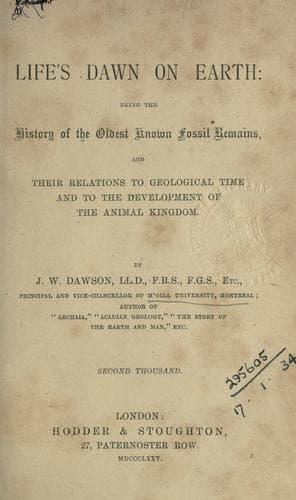
Life's Dawn on Earth: Being the history of the oldest known fossil remains, and their relations to geological time and to the development of the animal kingdomDawson, John William, Sir
History
Life's Dawn on Earth: Being the history of the oldest known fossil remains, and their relations to geological time and to the development of the animal kingdom
Dawson, John William, Sir
Life -- Origin; Paleontology -- Precambrian
Leaving the Eozoic age, we find ourselves next in the Primordial or
Cambrian, and here we discover the sea already tenanted by many
kinds of crustaceans and shell-fishes, which have been collected and
described by palæontologists in Bohemia, Scandinavia, Wales, and North
America;[AI] curiously enough, however, the rocks of this age are
not so rich in Foraminifera as those of some succeeding periods. Had
this primitive type played out its part in the Eozoic and exhausted
its energies, and did it remain in abeyance in the Primordial age to
resume its activity in the succeeding times? It is not necessary to
believe this. The geologist is familiar with the fact, that in one
formation he may have before him chiefly oceanic and deep-sea deposits,
and in another those of the shallower waters, and that alternations
of these may, in the same age or immediately succeeding ages, present
very different groups of fossils. Now the rocks and fossils of the
Laurentian seem to be oceanic in character, while the Huronian and
early Primordial rocks evidence great disturbances, and much coarse
and muddy sediment, such as that found in shallows or near the land.
They abound in coarse conglomerates, sandstones and thick beds of slate
or shale, but are not rich in limestones, which do not in the parts
of the world yet explored regain their importance till the succeeding
Siluro-Cambrian age. No doubt there were, in the Primordial, deep-sea
areas swarming with Foraminifera, the successors of Eozoon; but these
are as yet unknown or little known, and our known Primordial fauna is
chiefly that of the shallows. Enlarged knowledge may thus bridge over
much of the apparent gap in the life of these two great periods.
[Footnote AI: Barrande, Angelin, Hicks, Hall, Billings, etc.]
Public-domain text, read in full here on John Shaqi.
Reviews
Reviews
No reviews yet
Be the first to share your thoughts on this work.
Elsewhere in the archive
Join the Discussion
Join the discussion
Sign in to leave a comment or review.
Sign InorCreate an account