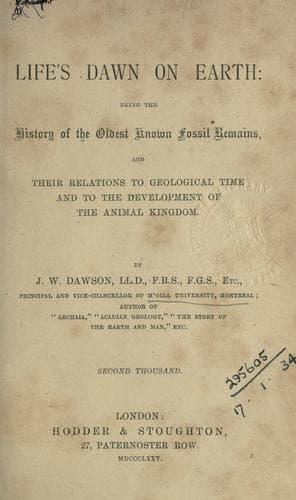
Life's Dawn on Earth: Being the history of the oldest known fossil remains, and their relations to geological time and to the development of the animal kingdomDawson, John William, Sir
History
Life's Dawn on Earth: Being the history of the oldest known fossil remains, and their relations to geological time and to the development of the animal kingdom
Dawson, John William, Sir
Life -- Origin; Paleontology -- Precambrian
7. Similar organic structures have been found in the Laurentian
limestones of Massachusetts and New York, and also in those of various
parts of Europe, and Dr. Gümbel has found an additional species in
rocks succeeding the Laurentian in age.
8. The manner in which the structures of Eozoon are affected by the
faulting, development of crystals, mineral veins, and other effects of
disturbance and metamorphism in the containing rocks, is precisely that
which might be expected on the supposition that it is of organic origin.
9. The exertions of several active and able opponents have failed to
show how, otherwise than by organic agency, such structures as those
of Eozoon can be formed, except on the supposition of pseudomorphism
and replacement, which must be regarded as chemically extravagant, and
which would equally impugn the validity of all fossils determined
by microscopic structure. In like manner all comparisons of these
structures with dendritic and other imitative forms have signally
failed, in the opinion of those best qualified to judge.
Another and perhaps simpler way of putting the case is the
following:--Only three general modes of accounting for the existence
of Eozoon have been proposed. The first is that of Professors King and
Rowney, who regard the chambers and canals filled with serpentine as
arising from the erosion or partial dissolving away of serpentine and
its replacement by calcite. The objections to this are conclusive.
It does not explain the nummuline wall, which has to be separately
accounted for by confounding it, contrary to the observed facts,
with the veins of fibrous serpentine which actually pass through
cracks in the fossil. Such replacement is in the highest degree
unlikely on chemical grounds, and there is no evidence of it in the
numerous serpentine grains, nodules, and bands in the Laurentian
limestones. On the other hand, the opposite replacement, that of
limestone by serpentine, seems to have occurred. The mechanical
difficulties in accounting for the delicate canals on this theory are
also insurmountable. Finally, it does not account for the specimens
preserved in pyroxene and other silicates, and in dolomite and calcite.
A second mode of accounting for the facts is that the Eozoon forms are
merely peculiar concretions. But this fails to account for their great
difference from the other serpentine concretions in the same beds, and
for their regularity of plan and the delicacy of their structure, and
also for minerals of different kinds entering into their composition,
and still presenting precisely the same forms and structures. The only
remaining theory is that of the filling of cavities by infiltration
with serpentine. This accords with the fact that such infiltration by
minerals akin to serpentine exists in fossils in later rocks. It also
accords with the known aqueous origin of the serpentine nodules and
bands, the veins of fibrous serpentine, and the other minerals found
Public-domain text, read in full here on John Shaqi.
Reviews
Reviews
No reviews yet
Be the first to share your thoughts on this work.
Elsewhere in the archive
Join the Discussion
Join the discussion
Sign in to leave a comment or review.
Sign InorCreate an account