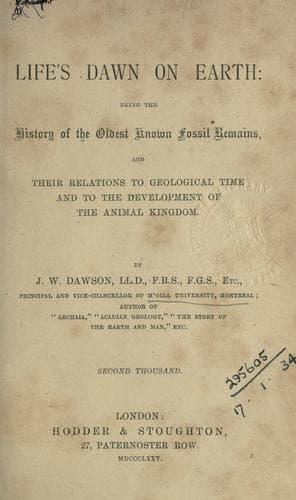
Life's Dawn on Earth: Being the history of the oldest known fossil remains, and their relations to geological time and to the development of the animal kingdomDawson, John William, Sir
History
Life's Dawn on Earth: Being the history of the oldest known fossil remains, and their relations to geological time and to the development of the animal kingdom
Dawson, John William, Sir
Life -- Origin; Paleontology -- Precambrian
Where in such a world would life be introduced? on the land or in the
waters? All scientific probability would say in the latter. The ocean
is now vastly more populous than the land. The waters alone afford
the conditions necessary at once for the most minute and the grandest
organisms, at once for the simplest and for others of the most complex
character. Especially do they afford the best conditions for those
animals which subsist in complex communities, and which aggregate large
quantities of mineral matter in their skeletons. So true is this that
up to the present time all the species of Protozoa and of the animals
most nearly allied to them are aquatic. Even in the waters, however,
plant life, though possibly in very simple forms, must precede the
animal.
Let humble plants, then, be introduced in the waters, and they would
at once begin to use the solar light for the purpose of decomposing
carbonic acid, and forming carbon compounds which had not before
existed, and which independently of vegetable life would never have
existed. At the same time lime and other mineral substances present in
the sea-water would be fixed in the tissues of these plants, either in
a minute state of division, as little grains or Coccoliths, or in more
solid masses like those of the Corallines and Nullipores. In this way
a beginning of limestone formation might be made, and quantities of
carbonaceous and bituminous matter, resulting from the decay of marine
plants might accumulate in the sea-bottom. Now arises the opportunity
for animal life. The plants have collected stores of organic matter,
and their minute germs, along with microscopic species, are floating
everywhere in the sea. Nay, there may be abundant examples of those
Amœba-like germs of aquatic plants, simulating for a time the life
of the animal, and then returning into the circle of vegetable life.
In these some might see precursors of the Protozoa, though they are
probably rather prophetic analogues than blood relations. The plant
has fulfilled its function as far as the waters are concerned, and now
arises the opportunity for the animal. In what form shall it appear?
Many of its higher forms, those which depend upon animal food or on the
more complex plants for subsistence, would obviously be unsuitable.
Further, the sea-water is still too much saturated with saline matter
to be fit for the higher animals of the waters. Still further, there
may be a residue of internal heat forbidding coolness, and that
solution of free oxygen which is an essential condition of existence to
most of the modern animals. Something must be found suitable for this
saline, imperfectly oxygenated, tepid sea. Something too is wanted that
can aid in introducing conditions more favourable to higher life in
the future. Our experience of the modern world shows us that all these
conditions can be better fulfilled by the Protozoa than by any other
creatures. They can live now equally in those great depths of ocean
Public-domain text, read in full here on John Shaqi.
Reviews
Reviews
No reviews yet
Be the first to share your thoughts on this work.
Elsewhere in the archive
Join the Discussion
Join the discussion
Sign in to leave a comment or review.
Sign InorCreate an account