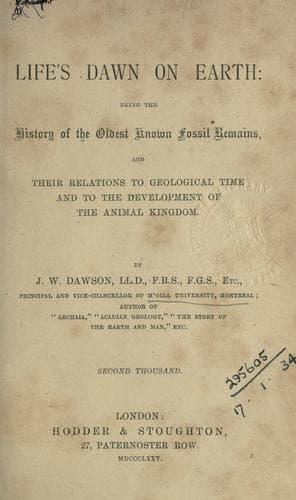
Life's Dawn on Earth: Being the history of the oldest known fossil remains, and their relations to geological time and to the development of the animal kingdomDawson, John William, Sir
History
Life's Dawn on Earth: Being the history of the oldest known fossil remains, and their relations to geological time and to the development of the animal kingdom
Dawson, John William, Sir
Life -- Origin; Paleontology -- Precambrian
"As it is convenient to have a name to designate these forms, I
would propose that of Eozoon, which will be specially appropriate to
what seems to be the characteristic fossil of a group of rocks which
must now be named Eozoic rather than Azoic. For the species above
described, the specific name of Canadense has been proposed. It may
be distinguished by the following characters:--
"Eozoon Canadense; _gen. et spec. nov._
"_General form._--Massive, in large sessile patches or irregular
cylinders, growing at the surface by the addition of successive
laminæ.
"_Internal structure._--Chambers large, flattened, irregular, with
numerous rounded extensions, and separated by walls of variable
thickness, which are penetrated by septal orifices irregularly
disposed. Thicker parts of the walls with bundles of fine branching
tubuli.
"These characters refer specially to the specimens from Grenville and
the Calumet. There are others from Perth, C. W., which show more
regular laminæ, and in which the tubuli have not yet been observed;
and a specimen from Burgess, C. W., contains some fragments of laminæ
which exhibit, on one side, a series of fine parallel tubuli like
those of Nummulina. These specimens may indicate distinct species;
but on the other hand, their peculiarities may depend on different
states of preservation.
"With respect to this last point, it may be remarked that some of
the specimens from Grenville and the Calumet show the structure of
the laminæ with nearly equal distinctness, whether the chambers are
filled with serpentine or pyroxene, and that even the minute tubuli
are penetrated and filled with these minerals. On the other hand,
there are large specimens in the collection of the Canadian Survey
in which the lower and still parts of the organism are imperfectly
preserved in pyroxene, while the upper parts are more perfectly
mineralized with serpentine."
* * * * *
[The following note was added in a reprint of the paper in the
_Canadian Naturalist_, April, 1865.]
"Since the above was written, thick slices of Eozoon from Grenville
have been prepared, and submitted to the action of hydrochloric acid
until the carbonate of lime was removed. The serpentine then remains
as a cast of the interior of the chambers, showing the form of their
original sarcode-contents. The minute tubuli are found also to have
been filled with a substance insoluble in the acid, so that casts
of these also remain in great perfection, and allow their general
distribution to be much better seen than in the transparent slices
previously prepared. These interesting preparations establish the
following additional structural points:--
Public-domain text, read in full here on John Shaqi.
Reviews
Reviews
No reviews yet
Be the first to share your thoughts on this work.
Join the Discussion
Join the discussion
Sign in to leave a comment or review.
Sign InorCreate an account