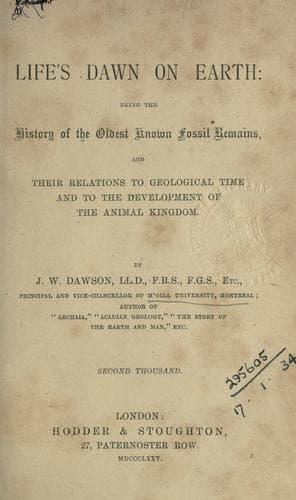
Life's Dawn on Earth: Being the history of the oldest known fossil remains, and their relations to geological time and to the development of the animal kingdomDawson, John William, Sir
History
Life's Dawn on Earth: Being the history of the oldest known fossil remains, and their relations to geological time and to the development of the animal kingdom
Dawson, John William, Sir
Life -- Origin; Paleontology -- Precambrian
"These reasons are, I think, sufficient to justify me in regarding
these remarkable structures as truly organic, and in searching for
their nearest allies among the Foraminifera.
"Supposing then that the spaces between the calcareous laminæ, as
well as the canals and tubuli traversing their substance, were once
filled with the sarcode body of a Rhizopod, comparisons with modern
forms at once suggest themselves.
"From the polished specimens in the Museum of the Canadian Geological
Survey, it appears certain that these bodies were sessile by a broad
base, and grew by the addition of successive layers of chambers
separated by calcareous laminæ, but communicating with each other by
canals or septal orifices sparsely and irregularly distributed. Small
specimens have thus much the aspect of the modern genera Carpenteria
and Polytrema. Like the first of these genera, there would also seem
to have been a tendency to leave in the midst of the structure a
large central canal, or deep funnel-shaped or cylindrical opening,
for communication with the sea-water. Where the laminæ coalesce, and
the structure becomes more vesicular, it assumes the 'acervuline'
character seen in such modern forms as Nubecularia.
"Still the magnitude of these fossils is enormous when compared with
the species of the genera above named; and from the specimens in the
larger slabs from Grenville, in the museum of the Canadian Survey,
it would seem that these organisms grew in groups, which ultimately
coalesced, and formed large masses penetrated by deep irregular
canals; and that they continued to grow at the surface, while the
lower parts became dead and were filled up with infiltrated matter or
sediment. In short, we have to imagine an organism having the habit
of growth of Carpenteria, but attaining to an enormous size, and by
the aggregation of individuals assuming the aspect of a coral reef.
"The complicated systems of tubuli in the Laurentian fossil indicate,
however, a more complex structure than that of any of the forms
mentioned above. I have carefully compared these with the similar
structures in the 'supplementary skeleton' (or the shell-substance
that carries the vascular system) of Calcarina and other forms, and
can detect no difference except in the somewhat coarser texture of
the tubuli in the Laurentian specimens. It accords well with the
great dimensions of these, that they should thus thicken their walls
with an extensive deposit of tubulated calcareous matter; and from
the frequency of the bundles of tubuli, as well as from the thickness
of the partitions, I have no doubt that all the successive walls, as
they were formed, were thickened in this manner, just as in so many
of the higher genera of more modern Foraminifera.
"It is proper to add that no spicules, or other structures indicating
affinity to the Sponges, have been detected in any of the specimens.
Public-domain text, read in full here on John Shaqi.
Reviews
Reviews
No reviews yet
Be the first to share your thoughts on this work.
Join the Discussion
Join the discussion
Sign in to leave a comment or review.
Sign InorCreate an account