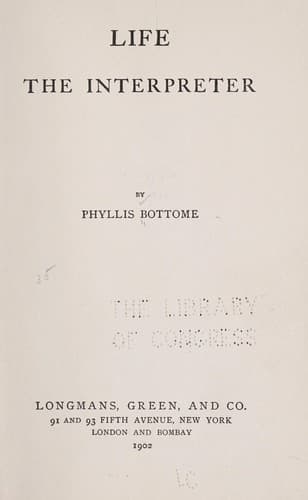
East End (London, England) -- Fiction; London (England) -- Social conditions -- Fiction; Social settlements -- Fiction
“There was another reason,” said the doctor slowly. Muriel was silent.
“Do you want to hear it?”
“If——” she began icily. “Yes, I may as well hear it,” she finished in
confusion. She did not want him to think she cared enough to be angry.
“I love you!” he said with the same quiet deliberation and a pause
between each word, “and it was a little difficult to let you help in any
other way.”
The room grew suddenly tense; each breath was a terrible sword which
shook the universe; there seemed an awful conspiracy in the room to win
some concession; the very chairs and table seemed to wait and listen. A
hand-organ in the street clanged them back into facts again. The doctor,
still looking at her, picked up a paper-knife; Muriel sank back into the
chair. There seemed nothing left in the world to say, but she felt as if
there might be if he would only keep still a moment.
“I am very sorry,” she said at last, and then she could have bitten her
tongue out, it sounded so commonplace. She noticed that he was looking
suddenly very tired, but he smiled with grave eyes.
“I knew you would be,” he said, “and I must go and make some calls. But
you do understand now, don’t you?”
“I suppose I do,” said Muriel; “but are you going away?” He almost
laughed at her thoughtlessness.
“Well! yes, Miss Dallerton,” he said; “I think I must go now.”
Muriel rose to her feet, and a great wave of desolation swept over her.
She stood there alone, and before her eyes passed the vision of those
who had left her—Alec—Jack—Cynthia—her uncle. All with their
different lives, their different circles. And now he was going, the
friend who had made life and her work, her youth and her beauty so
excellently well worth while—with whom she had argued, quarrelled and
discussed—and he was leaving her. All of a sudden she knew she could
not bear it—that she, too, needed help and comfort and sympathy—that
though one may give all and prosper, yet it is blessed to receive as
well. And then he looked so tired. He was waiting for her to dismiss
him, and he could not understand why she was keeping him.
“I don’t want you to go,” said Muriel at last. “I’m sure I need you
more—more than the other patients, only you must learn to ask questions
and not to make assertions only if you want me to be a satisfactory
case!”
“What made you say that you were sorry?” he asked her after a long,
wonderful pause.
“I was sorry,” she laughed at him, “that you didn’t tell me so before!”
* * * * *
When Jack heard of her marriage he shrugged his shoulders. “I always
thought she would run _amôk_ on some sort of a professional chap, but I
rather thought it would be a parson,” he said, and thought how much
better she might have done for herself if she had only known when she
had a good thing.
“I thought she was cut out for an old maid,” Edith le Mentier told her
friends; “but those sort of women generally marry and have fourteen
children.”
Public-domain text, read in full here on John Shaqi.
Reviews
Reviews
No reviews yet
Be the first to share your thoughts on this work.
Elsewhere in the archive
Join the Discussion
Join the discussion
Sign in to leave a comment or review.
Sign InorCreate an account