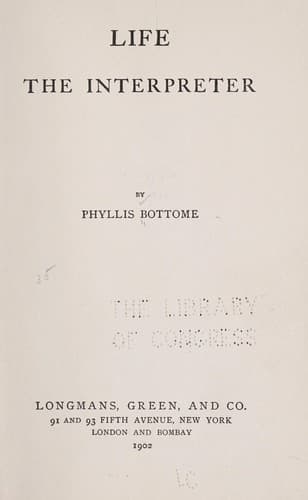
East End (London, England) -- Fiction; London (England) -- Social conditions -- Fiction; Social settlements -- Fiction
“Mrs. Huntly, may I come in to-morrow?” Mrs. Huntly saw in a flash it
had been no use.
“Oh, yes!” she said. “What a lot of moths you have in this climate of
yours. Good-night!”
The gorgeous moon, the thin low whisper of the tropic night, the
rustling, murmuring life, which rose from the earth to the low sky
above, seemed something of a new birth to Jack as free from the fetters
of an old love he paused on the brink of a new, and because it was new
imagined there would be no fetters.
CHAPTER XXI
“She crossed his path with her hunting noose, and over him drew
her net.”
GLADYS was the incarnation of sprightliness; her shimmering green dress
made her look like some beautiful heartless naiad of the woods.
When dinner was over she sang softly to Jim, letting her eyes rest on
him with a light caressing smile. Her own world had turned to paradise.
She was playing with sunbeams on a golden earth. It was impossible for
her to be anything but charming.
Mary was very tired. She sat and talked with her husband about the boy
at Eton; for a while at least she washed her hands of Gladys.
Finally the music stopped. Gladys’ hands sunk into her lap, and Jim
looking at her in an adoring simplicity set about for words which were
not too common to present to his goddess.
“I say” (the invocation seemed a little modern) “that’s an awfully
ripping dress you’ve got on to-night.”
“Do _you_ like it, Jim?” It was impossible for her to help the emphasis.
It had been said of her that if she were left alone in a desert she
would flirt with a camel. Jim would have sold his soul for a compliment,
but could only repeat:—
“Awfully!”
“Are you fond of being a soldier, Jim?” she asked. She was wondering why
Jack Hurstly did not come.
“I think it’s the grandest profession in the world!” he said proudly.
“People don’t do us a bit of justice except when there’s a row on, and
then they praise us for the wrong things. They don’t understand that a
man must be a decent sort of chap to win the respect of his men; and
there are fine chances, you know, that a fellow gets on the frontier to
show what he is made of. To hush up a disturbance or keep a district
quiet, are pretty good pieces of work. I hope you don’t think we’re all
of us brutes or blackguards, Miss Gladys?”
“No, Jim—oh, no!” said Gladys softly. “I think you’re the finest men in
the world, the most chivalrous to women, the strongest and the
gentlest—truest friend and noblest foe!” Jim thought it was too
beautiful for words, also that it was original; but it was not exactly
what he meant, and it put an end to the discussion.
“How does Captain Hurstly get on with his men?” she asked. It was
evident by her tone that she was not much interested in Captain Hurstly.
“Oh, well enough,” said Jim doubtfully. “Only you see he had rather a
bad time with a girl at home, and that rather put him off his work, I
think. He doesn’t seem as interested as he used to be.”
Public-domain text, read in full here on John Shaqi.
Reviews
Reviews
No reviews yet
Be the first to share your thoughts on this work.
Join the Discussion
Join the discussion
Sign in to leave a comment or review.
Sign InorCreate an account