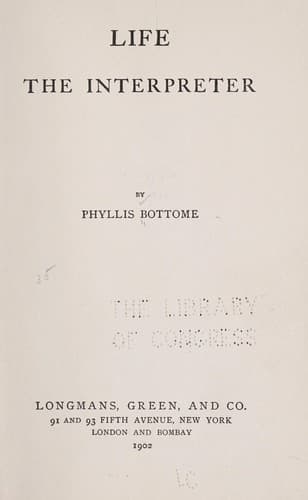
East End (London, England) -- Fiction; London (England) -- Social conditions -- Fiction; Social settlements -- Fiction
“I don’t believe he cared for her,” said Gladys shortly. If there is
nothing else to do with a clumsy fact, one can ignore it.
“Oh, yes, he did awfully,” said the unconscious Jim. “I never saw a
fellow so cut up before about a girl. She must have been a jolly
decent-looking girl, too—I’ve seen her photograph.”
“Really you’re very rude—you contradicted me flatly,” cried Gladys.
“Oh, but he _did_, you know,” said the over-truthful James. “_I_ didn’t
think she was so awfully fetching, though,” he added hastily, with the
bright hope that jealousy of _him_ might have promoted the frown he saw.
Gladys yawned.
“You’re very dull to-night,” she said, “doing nothing but talk of the
uninteresting love affairs of your uninteresting friends!” Jim flushed
angrily; he was conscious that he had not introduced the subject, but he
was too loyal to say so.
“I’m very sorry, Miss Gladys,” he said; “there’s something I’d much
rather talk about.”
“And that?” said Gladys, lifting unconscious eyelashes with innocent
ease.
“I think you know,” he said with the dignified gravity of extreme youth
over a compliment.
“If you mean me,” said Gladys smiling sweetly, “I think you’re very rude
to call me a ‘thing,’ and it’s horrid bad form to talk about a girl, you
know.” The rest of the evening passed in a pleasant, dangerous fashion.
At parting Jim wore the rose she herself had worn at dinner. It was the
pledge of all dear, impossible things to him; it was the usual
termination of an evening’s episode to her—a gardener would have
accused it of blight.
CHAPTER XXII
“The truth was felt by instinct here—
Process which saves a world of time.”
DESPERATION, when it does not rave, becomes a calm; and it was with an
almost listless quiet that Cynthia, sitting opposite her brother in his
office, told him she was going away.
He nodded briefly, and went on writing prescriptions. He had not quite
finished his evening’s work. The boy was to deliver them to his
patients. The room was bare and light, with the usual rows of medical
books, long suggestive chair, and the sturdy boy standing near a
forbidding cupboard.
Cynthia’s eyes took in the surroundings as if they had been new to her.
She had argued bitterly with her brother over having no lamp-shades, and
the naked bright skeleton roused in her now a sense of irritation. Would
Geoff never be done, and why was he so little interested in her going
away?
But he had always been a man of one idea, she thought, and what interest
he had was buried in his prescriptions. Ten minutes later he sent off
the boy with a curt order or two, then he turned and looked at his
sister.
“Going away, are you?” he said. He might have been drawing out a shy
child, or encouraging a nervous patient. Cynthia shrugged her shoulders.
“So I told you.”
“Have you thought why, or where, or when?”
Public-domain text, read in full here on John Shaqi.
Reviews
Reviews
No reviews yet
Be the first to share your thoughts on this work.
Join the Discussion
Join the discussion
Sign in to leave a comment or review.
Sign InorCreate an account