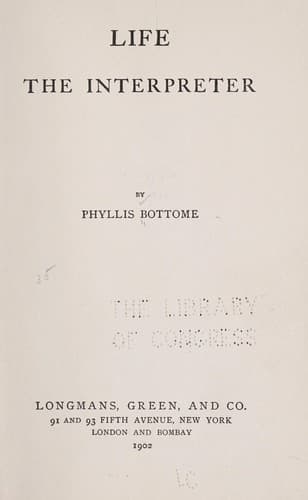
East End (London, England) -- Fiction; London (England) -- Social conditions -- Fiction; Social settlements -- Fiction
The word that fell in the hot still morning lived ever afterwards in
Jack’s mind with the heavy scent of tropical flowers, the restless
quiver of the air, and the sharp metallic stroke of a coppersmith’s beak
near by. She was unhappy, and pretty, and clinging—and she loved him.
Had he any right to make her love him so, and then leave her to a bitter
and miserable marriage? So pity spoke, and the beauty of the girl’s
lithe form, the curl of hair just escaping the uplifted hand, the
delicate scent she used, the whole scene with its setting of the old hot
Indian garden spoke to passion. And when pity and passion speak at the
same moment, reason, sense, and self-control fade fast away. He took her
hands from her face; she looked at him as a startled child would look;
he felt the beating of her heart; he drew her closer to him, and she
made no resistance.
“Gladys, Gladys, will you be happy with _me_, darling?” he asked her.
“Oh, Jack!” she cried, “you never even asked me—if I loved you!”
An hour later, radiant, triumphant, cruel, Gladys stood before Tom
Huntly.
“I am not going back to England with you,” she said. “I am going to
marry Jack Hurstly. I shall stay with Mrs. Collins till the wedding, and
come home with Jack, for good.” Tom Huntly looked at her, alive and
young! and upstairs lay the body of his wife, and the girl could be so
happy!
“Are you quite heartless?” he asked wearily. The insolence of her joy
turned to weak self-pity, and she began to cry again.
“Oh, poor, poor Mary!” she sobbed. “She _so_ wanted to help me choose my
trousseau!” Tom left the room, shutting the door after him.
Jack went back to his quarters. He wondered why the scent she wore
seemed so familiar. He remembered at last that Edith le Mentier had used
it too, and he remembered at the same time with equal irrelevancy that
Muriel never used scent.
That evening he had a long talk with Tom Huntly. His friendship with
Mary had been a deep and real one, and he thought Gladys must have been
mistaken about Tom’s brutality. He was not that sort of man; and he
thought Tom was equally mistaken when he said rather doubtfully, “I hope
you will be happy with Gladys; she’s not half up to the form of that
other girl of yours.”
Any reference to Muriel was peculiarly irritating to him just now.
It also seemed that people who knew Gladys very well did not appreciate
her so deeply as people who knew her slightly—a trait which is
certainly a trifle unfortunate in a man’s future wife. But he had burned
his boats, and he remembered how pretty she was, and tried to think it
very natural that the day after his engagement he should find his
_fiancée_ playing love-songs on the piano to her very distant
connection, Jim Musgrave.
CHAPTER XXVIII
“Is she not pure gold, my mistress?”
Public-domain text, read in full here on John Shaqi.
Reviews
Reviews
No reviews yet
Be the first to share your thoughts on this work.
Elsewhere in the archive
Join the Discussion
Join the discussion
Sign in to leave a comment or review.
Sign InorCreate an account