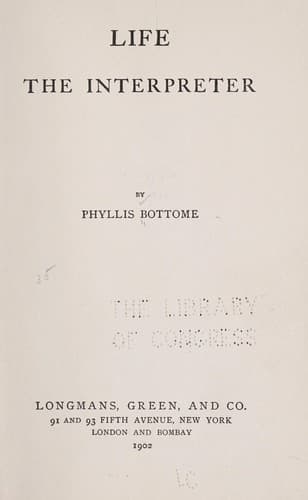
East End (London, England) -- Fiction; London (England) -- Social conditions -- Fiction; Social settlements -- Fiction
They only parted at bedtime at his mother’s door on the express
understanding that he was to come again the next day, and that knights
never even under the hardest circumstances cried, and that last, but not
least, the coal-black charger with a stiff neck under the king’s coat
transported thither from a fairy shop must be shown without delay to
Marie, daddy and the cook. These facts being grasped the worst was over,
and the knight, strewing wet kisses in his wake, was borne away to bed,
leaving his volatile mother expressing shrill-voiced thanks to Cynthia
and Geoff. The streets seemed ten times brighter and less chilly to the
doctor and his sister, and they went to a screaming French farce for the
rest of the evening, and felt much the better for it. In fact they even
forgot for a while their determination to enjoy themselves.
After this it became the custom for Launcelot to go to Cynthia every
afternoon and stay with her till evening. Millicent was always grateful,
but frequently hurried—more hurried even than an American woman in
Paris generally is. She did not refer again to the charming Count and
his sister, but one day she told Cynthia that “Clifton had gone away.”
“For how long?” asked Cynthia quietly. Millicent stared, then she sat
down and laughed. She laughed for a long while, but not very merrily.
Finally she explained with a blank terseness.
“He’s just quit; he’s gone! he’s left me. Don’t stand there and stare,
Cynthia. Sit down. We didn’t have a very good time together.” She
continued pacing restlessly up and down the little tawdry room. “He was
always the sort of man that wanted a good time, and we didn’t have much
money. After the child came, you know, it was worse than ever. I wasn’t
going to play the door-mat to Clifton, but I did my best to make it
pretty.” She looked at the little concealments, ragged and thin in the
heartless Paris sunshine, and they looked more pathetic than ever. “And
I dressed real well, but there wasn’t any keeping him. He only told me I
was ruining him with dressmakers’ bills, though he knew I make the most
of my own clothes! Sometimes I wish I hadn’t been so cock-sure about
Paris. In America there’d have been something to keep him back, but
there’s nothing to keep one back in Paris. Things look as innocent and
pretty——” her voice broke; “but they aren’t, Cynthia—they’re real
mean! they’re real mean!” Cynthia sat silently gazing at the carpet. The
nervous, breaking voice, the frightened, restless figure were not lost
upon her. They seemed familiar somehow, quite as if she had seen them
before; and the ring of pain in the most meagre phrase “But they
aren’t—they’re real mean! they’re real mean!” voiced a feeling that had
once been part of her without a voice. She waited for the inevitable
sequel. It came in a burst of hysterical sobs. “He left me a note,
Cynthia—Clifton did—he said I should know where to look for
consolation!”
“The brute!” cried Cynthia. Millicent laughed.
Public-domain text, read in full here on John Shaqi.
Reviews
Reviews
No reviews yet
Be the first to share your thoughts on this work.
Elsewhere in the archive
Join the Discussion
Join the discussion
Sign in to leave a comment or review.
Sign InorCreate an account