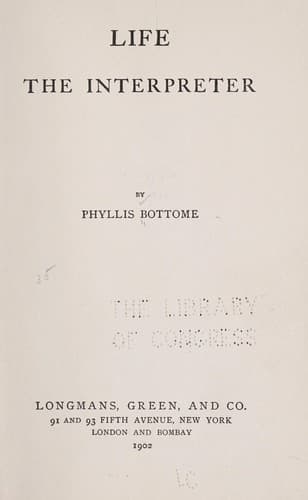
East End (London, England) -- Fiction; London (England) -- Social conditions -- Fiction; Social settlements -- Fiction
“I don’t believe you ought to have looked for me,” she replied gravely,
for she was afraid.
“What made you run away, Cynthia?” he asked. She could give him any
reason but the right one. She chose to deny the charge.
“I didn’t run away,” she said; “I merely wanted to come to Paris.”
“Then why shouldn’t I look for you?” cried Leslie triumphantly; “I
merely wanted to come too.”
“I don’t know where we are going to,” said Cynthia, looking at him to
see if he was much altered.
“I don’t think it in the least matters providing we go there together,”
laughed Damores. “As it happens, here’s a cemetery; shall we go in and
look at the tombstones?” Cynthia laughed as well. It was too absurd to
think of death. There were lines in his face; he must have missed her a
good deal. They went into the cemetery together. A husband who had come
to put some flowers on the grave of his dead wife thought them
heartless. They were not heartless, they were only too happy to remember
they had hearts at all.
“Now you have come, what are you going to do?” she asked at last. She
could not meet his eyes now; the things they meant cried too loudly for
an answer.
“I am going to marry you,” he replied smiling, “if you’ll let me. I
don’t think anything else matters just at present.” Cynthia felt the
color in great rebellious waves sweep over her face. She looked with
unseeing eyes at the wreaths of absurdly artificial flowers.
“Do you fully realize what that means, Leslie?” she asked. “Can you face
everything—everything?”
“Everything! everything!” said Leslie quietly, “with you; without you I
cannot live my life. You are the best of everything I do. You never came
to see my picture—it would have told you all. Once I made a tremendous
mistake. It seems a crime when I look back. There is only one thing that
can ever wipe it out. Cynthia, is it too late to ask you to be my wife,
and overlook the past?” She could not speak, her heart thundered, and
seemed to shake the ground she stood on.
God had given her a tremendous reward, a gift unspeakable after she had
renounced what had been to her the very hope of joy, and from the lips
of the man she loved pardon and oblivion swept her sin into the free,
pure waters of love. She lifted up her eyes to him that he might read
there all her heart and soul his eternally and for ever. For a long
while silence came down and covered them. They turned at last, and
slowly and without speaking left the place of tombs—the acre of God’s
sleeping ones. The man who had been stung by their laughter, seeing
their faces again, recalled his injury. “After all,” he thought, “they
had their business here.” And he was right, for love and death live in
no separate houses.
CHAPTER XXXV
“A man’s reach should exceed his grasp.”
—ROBERT BROWNING.
Public-domain text, read in full here on John Shaqi.
Reviews
Reviews
No reviews yet
Be the first to share your thoughts on this work.
Elsewhere in the archive
Join the Discussion
Join the discussion
Sign in to leave a comment or review.
Sign InorCreate an account