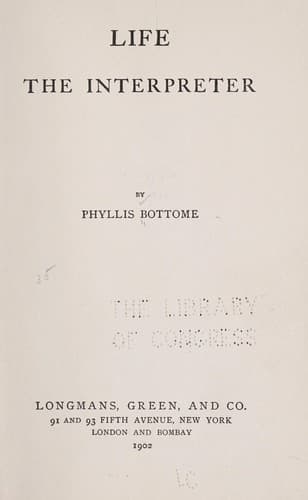
East End (London, England) -- Fiction; London (England) -- Social conditions -- Fiction; Social settlements -- Fiction
“And are you going to live in London?” she asked Gladys, studying the
girl’s face, the defiant sad eyes and peevish mouth, the fretful
restlessness of the dainty figure. Pity was killing the last traces of
her disappointment in her. Gladys returned her gaze curiously; she was
thinking how becoming black was to Muriel.
“Oh, yes!” she said; “I suppose we shall practically live here. I hate
the country, you know, except for house-parties, and Jack’s estate is
particularly dreary, I think. I hate ‘estates,’ they’re like
appropriated pews, one always wants to sit somewhere else! Have you
given up your club craze yet? Your uncle’s death must have made a lot of
difference to you?” Muriel smiled.
“If you mean am I horribly rich? I’ll admit it, but it will make the
‘club craze’ flourish more than ever, I expect. I have bought up three
houses in Stepney and turned them into one for a settlement of workers.
I am making arrangements now to enlarge the club, and in two or three
weeks I shall go back to it.” There was a slight pause. Gladys played
with some violets in a stand. “Are you quite happy?” said Muriel at last
very gently. “I hope, dear, you are quite happy?” It appeared to Gladys
absurd to suppose she could possibly mean it, yet the tone sounded
sincere.
“Happy?—of course we are! Why we have only been married a few months,
and Jack has discovered I wear my own hair and keep my own complexion,
and I am reassured as to the harmlessness of his habits and the extent
of his income. What more can one ask?”
“Those in themselves might add to your unhappiness if you were so
already, but they could scarcely succeed in _making_ you happy, I am
afraid,” said Muriel quietly.
“Wouldn’t _you_ be happy with—Jack?” questioned Gladys. Sorrow, if it
doesn’t increase tenderness, tends to brutality. Muriel met her eyes
calmly.
“No,” she said slowly, “I do not think I should be quite happy—with
Jack.” She did not refer to their broken engagement. Gladys expected her
to, and was touched.
“It was horrid of me to say that,” she said, “if you still care for him,
and rude of me if you don’t.”
“I don’t think you either rude or horrid,” said Muriel quietly, “only
not quite happy. I am very sorry for you, dear, because, though I don’t
care for Jack as I did, he made me very miserable once.” Gladys pulled
two violets to pieces on her lap. Muriel shivered; she hated wanton
destruction of anything, and she loved flowers.
“I have behaved very badly to you,” said Gladys at last in a low voice.
“It was I that helped Edith le Mentier make trouble between you and
Jack.”
“You loved him so?” asked Muriel gently. Gladys burst into tears.
“I don’t know why you should treat me like this,” she sobbed, “for I did
my best to ruin your life, and I would again to get—Jack!” Muriel took
her in her arms; all her old love and pity returned to her.
“It would make no difference to me if you did,” said Muriel; “I should
only be sorry for you. Tell me what’s the matter?”
Public-domain text, read in full here on John Shaqi.
Reviews
Reviews
No reviews yet
Be the first to share your thoughts on this work.
Elsewhere in the archive
Join the Discussion
Join the discussion
Sign in to leave a comment or review.
Sign InorCreate an account